
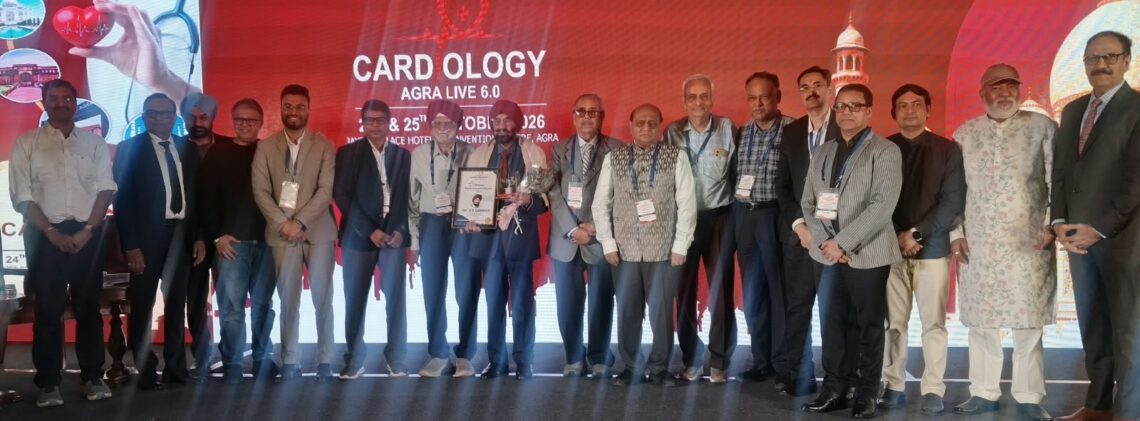
Agra Interventional Cardiology Society Organises Two-Day National Conference at Hotel Jaypee Palace; 450 Delegates Participate in 20 Technical Sessions
Agra: The Agra Interventional Cardiology Society organised the two-day national conference Cardiology Agra Live 6.0 at Hotel Jaypee Palace, Agra, bringing together leading cardiologists and medical experts from across the country. On the first day, approximately 450 delegates participated in 20 technical sessions covering heart failure, coronary artery disease, aortic disorders, cardiac surgery and structural heart interventions, including Transcatheter Aortic Valve Replacement (TAVR).
Lifestyle Changes Essential for a Healthy Heart: Dr Suveer Gupta
Conference Organising Secretary Dr Suveer Gupta emphasised the importance of adopting a healthy lifestyle to prevent heart disease. He advised people to quit tobacco, bidis, cigarettes and alcohol, incorporate regular walking into their daily routine, and remain particularly vigilant if there is a family history of heart disease.
He highlighted that diabetes combined with smoking significantly increases cardiovascular risks and stressed the importance of preventive care and early medical intervention.
Heart and Kidney Health Are Closely Connected: Dr Himanshu Yadav
Speaking on “Heart Failure – Kidney Is the Key,” Dr Himanshu Yadav explained that heart and kidney health are closely interconnected. Dysfunction in either organ can adversely affect the other, making early diagnosis, regular monitoring and appropriate treatment essential for patients suffering from heart or kidney diseases.
Advanced Angioplasty Offers Hope to Patients Deemed Unfit for Surgery: Dr Subhash Chandra
Dr Subhash Chandra from New Delhi highlighted the remarkable advances in interventional cardiology. He explained that complex coronary angioplasty is increasingly being performed in elderly and high-risk patients who were previously considered unsuitable for surgery.
Advances in medical devices and specialised techniques have expanded treatment options for patients with complex coronary artery disease. Procedures such as TAVR, MitraClip and tricuspid valve interventions have also made it possible to treat several serious heart valve conditions without conventional open-heart surgery in appropriately selected patients.
Balancing Ischaemic Protection and Bleeding Risk in Dual Antiplatelet Therapy: Dr Sumeet Sethi
Dr Sumeet Sethi from New Delhi discussed the importance of balancing protection against ischaemic events with bleeding risks when prescribing dual antiplatelet therapy (DAPT) after acute coronary syndrome (ACS).
He explained that prasugrel and ticagrelor are generally more potent than clopidogrel following coronary intervention. However, prasugrel should not be prescribed to patients with a history of stroke or transient ischaemic attack (TIA). Clopidogrel remains an important option for patients with a high risk of bleeding, depending on their clinical circumstances.
Minimally Invasive Treatment Must Prioritise Patient Safety: Dr Subrata Akhauri
Dr Subrata Akhauri from Faridabad said that an increasing number of patients prefer minimally invasive procedures over open surgery. Medical advances have made several treatment options possible that were previously difficult to imagine.
He emphasised two essential principles for patient safety: minimising complications and ensuring a well-organised treatment system. Appropriate patient selection, accurate counselling and systematic treatment planning are crucial to reducing complications.
Potassium Management Is Critical in Heart and Kidney Patients: Dr Jitendra Kumar
Dr Jitendra Kumar from Faridabad discussed the management of hyperkalaemia, or elevated potassium levels, in patients with heart failure and chronic kidney disease (CKD).
He explained that life-saving treatments affecting the renin-angiotensin-aldosterone system (RAAS), including mineralocorticoid receptor antagonists (MRAs), can increase potassium levels in some patients. He highlighted the role of sodium zirconium cyclosilicate (SZC), which can begin lowering potassium within an hour.
Referring to the REALIZE-K trial, he discussed how potassium management can help eligible patients continue spironolactone therapy. He emphasised that careful monitoring and appropriate management may be preferable to discontinuing beneficial medication without exploring suitable alternatives.
What Happens When a TAVR Valve Degenerates? Dr Viveka Kumar Explains
Dr Viveka Kumar from Max Hospital, Saket, New Delhi, discussed the management of valve degeneration following TAVR, a procedure that has transformed the treatment of aortic stenosis.
He explained that valve degeneration may present as stenosis or regurgitation and must be distinguished from conditions such as valve thrombosis, endocarditis and paravalvular leakage.
An integrated assessment using echocardiography and CT scans is essential. Depending on the patient’s condition, treatment options may include surveillance, anticoagulation, valve-in-valve TAVR or surgical valve removal in selected cases. He stressed the importance of multidisciplinary heart-team evaluation and lifelong follow-up.
New Heart Failure Guidelines Emphasise Prevention and Early Diagnosis: Dr Gajinder Goel
Dr Gajinder Goel from Faridabad discussed developments in heart failure management and the importance of prevention, early identification and timely treatment.
He highlighted risk assessment, improved use of evidence-based medications and emerging treatment approaches for selected patients with heart failure and obesity. He emphasised that early diagnosis and appropriate treatment can improve patient outcomes.
Life-Threatening Complications After a Heart Attack Can Be Treated Without Open Surgery: Dr Rajagopal J.
Dr Rajagopal J. from Mysuru explained that although primary angioplasty has become the standard treatment for many patients experiencing an acute heart attack, severe structural complications such as acute severe mitral regurgitation remain challenging.
Traditionally, such cases often required high-risk emergency open-heart surgery. He discussed how minimally invasive techniques, including the MitraClip procedure in suitable patients, can repair the mitral valve without conventional open surgery and potentially facilitate faster recovery.
HFpEF: Normal Pumping Capacity Does Not Rule Out Heart Failure
Dr Varun Sharma from Agra explained that nearly half of heart failure patients may have a preserved ejection fraction, a condition known as heart failure with preserved ejection fraction (HFpEF).
Patients may experience fatigue, breathlessness and swelling even when echocardiography shows a normal ejection fraction. Consequently, the condition can be overlooked unless risk factors, clinical scoring systems and biomarkers are assessed appropriately.
High blood pressure, diabetes, obesity and atrial fibrillation are among the important associated risk factors. Timely diagnosis is essential for effective management.
Four Pillars of Heart Failure Treatment and Emerging Vericiguat Therapy: Dr Saurabh Nagar
Renowned cardiologist Dr Saurabh Nagar discussed the four foundational pillars of treatment for heart failure with reduced ejection fraction (HFrEF), along with the role of vericiguat in selected patients.
He emphasised that timely, evidence-based treatment can improve patients’ quality of life and reduce cardiovascular risks. Vericiguat may be considered for eligible patients with worsening heart failure to reduce the risk of further heart failure hospitalisation and cardiovascular complications.
He added that advances in treatment and emerging clinical evidence are creating new possibilities for patients with severe heart failure.
Padma Shri Dr Daljit Singh Gambhir Honoured with Lifetime Achievement Award
A major highlight of the conference was the presentation of the Lifetime Achievement Award to renowned cardiologist Padma Shri Dr Daljit Singh Gambhir in recognition of his contributions to the field.
An echocardiography book focusing on the fundamentals of the subject was also launched. A knowledge-sharing debate on cardiology was organised under the coordination of Dr Tarun Singhal.
Padma Shri Dr D.S. Gambhir, Dr Umar Hasan and Dr Anil Bhan, among several other specialists, shared their research and clinical insights. Dr Sharad Paliwal, Dr Kailash Vishwani, Dr S.K. Kalra and Dr Ishan Gupta also contributed to the discussions.
Dr Sharad Paliwal, Dr A.K. Gupta, Dr Rajneesh Singh, Dr D.P. Agrawal, Dr Siddharth Agrawal, Dr Anil Saraswat, Dr K.K. Vishwani, Dr Vikas Jain, Dr Vijay Khurana, Dr Anand Rawat, Dr Durgesh Sharma, Dr Jyoti Garg, Dr V.N. Kaushal, Dr Tarun Mittal, Dr Rajiv Chugh, Dr S.K. Kalra, Dr Sachin Goel and Dr Amit Gupta served as panellists and chairpersons in various sessions.
Devendra Dhal conducted the proceedings, while Suresh Singh coordinated the arrangements. The national conference was inaugurated with the ceremonial lighting of the lamp by Padma Shri Dr D.K. Hazra.
Special Echocardiography Workshop for Medical Students on October 25
Organising Secretary Dr Suveer Gupta announced that a special hands-on echocardiography workshop for medical students will be held on October 25, from 11 am to 2 pm, at Hotel Holiday Inn, Sanjay Place, Agra.
The workshop will provide practical training in measuring left ventricular ejection fraction (LVEF), identifying heart valve abnormalities and interpreting echocardiography reports.
The initiative aims to strengthen the practical knowledge and diagnostic skills of medical students while promoting advances in cardiovascular care.