
S. Muneer: Aligarh
There has not been an AMU Students Union for the last eight years, while all the time the students have been paying the dues for the Union stand unutilised. These unutilised funds must have generated interest, even if simply in an account at a Bank. The calculations presented in the Times of Taj are revised in the light of a leading English Daily of there being twenty-four thousand five hundred (24,500) students. The figure most probably are provided by the University, as it has not contradicted the claim of the daily.
In view of this number of students and assuming that each student is charged one hundred fifty rupees (Rs. 150/-) then the estimate of accumulated funds over the past 08 years is to the tune of crore ninety four lac rupees (2, 94, 00, 000), nearly three (03) crores. However, some claim that the fee was raised to two hundred rupees (Rs. 200/-), which stands verification. However, this would mean funds accumulated over the last eight years to be three lacs ninety two thousand. Therefore, there is definitely a possibility of the funds being between three (03) and four (04) crores.
The transfer from the AMU Students Funds, it is learnt, has been approved by the Academic and Executive Council. A motion in statutory bodies of the University is moved either by the Vice Chancellor or by a single member or a group of members of the body, whose name(s) are mentioned in the minutes. In the meeting of the Academic Council meeting of 30.06.2026 under Item no. 45 a motion was moved that was then approved by the Executive Council on 25.08.2026 Item no. 23 that ‘unutilised funds’ shall be transferred to the AMU Corpus Funds. It is rumoured that without consulting the students, whose money it is, the AMU Students Funds are transferred to the AMU Students Funds. It is also learnt that from the estimated three (03) to four (04) crores only forty lacs are left in the AMU Students Funds, which will be utilised during the elections and the remaining will be left for the AMU Students Union for the remaining year.
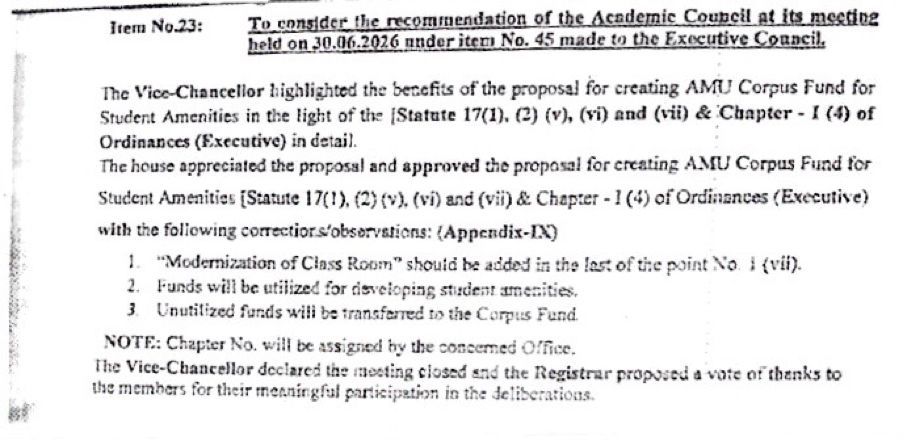
The resolution of the Executive Council at point three (03) clearly states “Unutilized funds will be transferred to the Corpus Fund”. Interestingly, there is no approval by the AMU Students Union at any time whose money it is. Some senior students speculate that this might have been the reason for not holding AMU Students Union elections, so that the accumulated amount then may be transferred and then utilised, without the consent of AMU Students Union or it is a very big coincidence that immediately after the approval of the Executive Council the AMU Students Union elections are called. These senior students feel that it will be responsibility of the elected members of the Union that the AMU Students Union Funds are restored, so that the Union through a democratic process decides how to utilise these funds for the benefit of the students, such a scholarships; etc.
The resolution of the Executive Council states that the resolution is in accordance with Statute 17(1), (2)(v) & (vi) and Clause 4 of Chapter 1 of the Ordinances (Executive). It is interesting that a corpus fund is an amount donated, which the AMU Students Union never did. However, the Academic Council has no jurisdiction to decide how the AMU Students Union Funds can be utilised. Then again, Statute 17(1) clearly states the “Executive Council shall have the management and administration of the revenue…of the University…”, depriving the Academic Council to deliberate on the financial matters. The Executive Council understands that AMU Students Union Funds as revenue generated, whereas the AMU Students Union Funds cannot be considered so. Again, Statute 17(2)(v) states “to manage and regulate the finances” of the University, whereas the AMU Students Union Fund are not finance of the University but of the AMU Students Union to be utilised by it. Statute 17(2)(vi) clearly states that the Executive Council is “to invest money belonging to the University” obviously declining to treat the AMU Students Union Funds as money of the Union. Amazingly, Chapter 1 of the Ordinances (Executive) is titled Funds of the University and Clause 4 is about Trust Fund which has nothing to do with the AMU Students Union Funds. Trust Fund is a legal and financial arrangement where a trustee holds and manages assets on behalf of the beneficiary, whereas the University has not treated the AMU Students fund as a trustee. A senior professor of the University points out that the Executive Council resolution is not tenable since the law quoted in it has nothing to do with the AMU Students Funds. In a visibly hurried procedures it has been forgotten that reappropriation of funds cannot take place without the Finance Committee of the University, and therefore any implementation would be blatantly illegal.
The students of the University stunned argue that the Union to be elected will have to defend and recover the AMU Student Union Funds and students’ rights, which appear to be trampled underfoot by the University. A considerable number of students argue that the reason for not holding elections to the Union was to accumulate a substantial amount which can then be transferred to the Corpus and utilised at the sweet will of the Vice Chancellor. The students of Law add that the decisions of the Academic and Executive Councils pose a direct, systemic threat to student welfare, financial autonomy, and rights. They incessantly repeat that the administration is pushing through a policy to systematically absorb unspent student funds into a centralized university corpus. There is a possibility, say some senior students, that we may again see no AMU Students Union and then the unutilized in AMU Students Union Fund will be absorbed into the central Corpus Fund. The active students on the Campus are suggesting a representation signed by the students to the President of India, the Visitor of the University, to declare the resolution of Academic and Executive Council void being deprived of any legality. The law students also argue that Corpus Funds are endowments, i.e. donated by people specifying the purpose, but there are no such players in this case.