
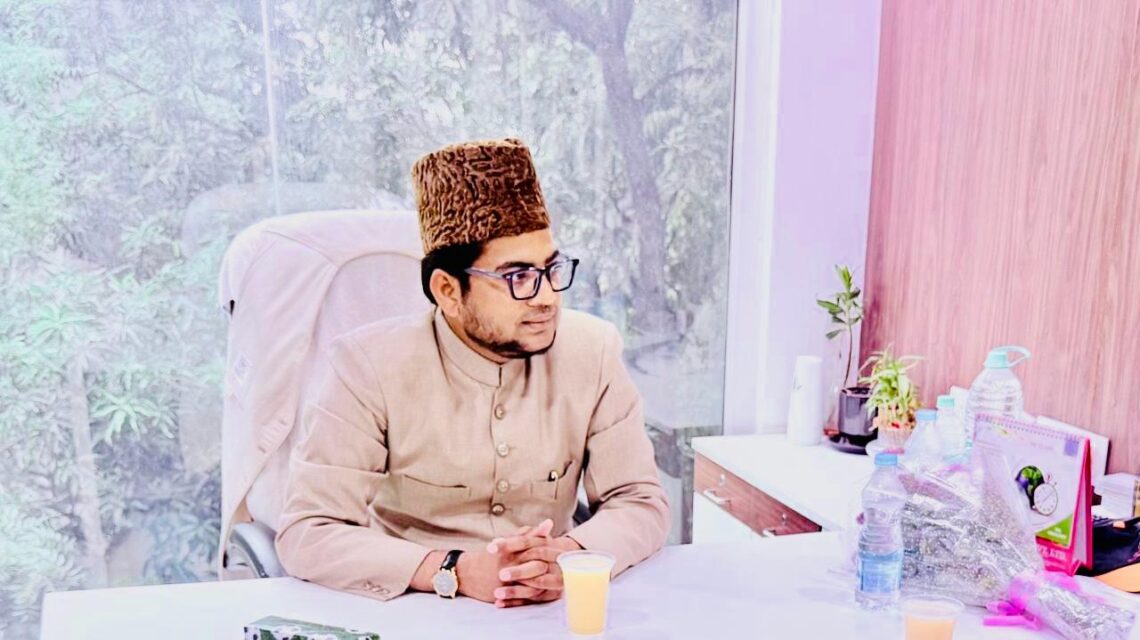
Dr. Raihan Akhtar
Assistant Professor,
Faculty of Religious Studies,
Aligarh Muslim University,
Aligarh
Email: raihanhams6@gmail.com
The Muslim youth of the present time is living amid such a flood of information where distinguishing between truth and falsehood, reason and emotions, and knowledge and rumor has become far more difficult than before. Events taking place across the world, social injustice, religious differences and the countless voices of the digital world continuously generate questions in their minds. In such an environment, the need is not merely to present a list of prohibitions, but to develop such a balanced religious insight that can connect faith with reason, emotions with morality, and differences with justice. The Quran, Hadith and the Seerah of the Prophet Muhammad, peace and blessings of Allah be upon him, provide the fundamental guidance for this intellectual balance.
To understand Islamic teachings, it is first necessary to present its perspective regarding human life. At a time when the value of a human being sometimes begins to be determined on the basis of religion, caste, race or political affiliation, the Quran gives human life a high moral status. Allah says:
“Whoever kills a soul, unless in retribution for a soul or for spreading corruption on earth, it is as if he has killed all mankind; and whoever saves one, it is as if he has saved all mankind.”
(Al-Ma’idah, 5:32).
Imam Al-Qurtubi, may Allah have mercy upon him, has included the sanctity of human life among the great objectives of the Shariah under this verse and has clarified that protecting human life is also a religious obligation. (Tafsir Al-Qurtubi, Surah Al-Ma’idah, verse 32)
The Seerah (biography) of the Messenger of Allah, peace and blessings of Allah be upon him, gives practical form to this principle. During a Ghazwah, when a woman was found dead, the Prophet, peace and blessings of Allah be upon him, expressed his disapproval of her killing and prohibited the killing of women and children. (Sahih Bukhari, Hadith 3014).
This makes it clear that even war is not free from moral limits; hostility cannot become a general justification for depriving a human being of his basic rights. This is why, in the Islamic concept of justice, means are as important as ends. Today, when the humanitarian tragedies occurring in different parts of the world reach young people directly, anger against oppression is natural, but Islam seeks to place this anger under justice and morality rather than allowing it to become an uncontrolled reaction. In this way, compassion does not remain merely an emotion, but takes the form of a moral principle.
After the sanctity of human life, another fundamental question is how religious commands and events should be understood. Many times, the problem is not with the teaching of religion, but with the method of studying it. A verse is taken separately, half the meaning of a Hadith is presented, and then an understanding of the entire religion is formed on that basis. Instead of this tendency, the Quran presents the principle of investigation and verification. The Quran says:
“O believers! If a disobedient person brings you any news, verify it thoroughly, lest you unknowingly harm a people and then become regretful for what you have done.”
(Al-Hujurat, 49:6).
According to Imam Ibn Ashur, may Allah have mercy upon him, verification of information is of fundamental importance for the stability of social life; a decision based on unverified information can become a cause of collective harm. (At-Tahrir wa’t-Tanwir, Surah Al-Hujurat, verse 6)
The same principle is confirmed by this saying of the Messenger of Allah, peace and blessings of Allah be upon him. He said:
“It is enough for a person to be considered a liar that he narrates everything he hears.”
(Sahih Muslim, Hadith 5).
Today, this teaching is no longer merely a moral exhortation. In a short clip, half of a Hadith; in a picture, half of a Quranic verse; or an emotional fragment of a historical event can begin to represent the entire religious perspective. Therefore, it is not enough merely to tell young people what is right and what is wrong; they must also be taught an epistemological method for reaching the truth. This awareness protects them from becoming mere consumers of emotional religious content and turns them into serious students.
The need for this intellectual caution is also clearly visible in the question of Jihad and Qital (armed struggle). In modern discourse, these two terms are often used with the same meaning, whereas in the Islamic intellectual tradition their meanings are not identical. The meaning of Jihad is broad and includes various forms of struggle and effort, whereas Qital relates to specific circumstances of armed conflict. Ignoring this distinction reduces a broad religious concept merely to the meaning of war. The Quran lays down a clear principle regarding war. Allah says:
“And if they incline towards peace, then incline towards it and put your trust in Allah.”
(Al-Anfal, 8:61).
Imam Ibn Kathir, may Allah have mercy upon him, explains under this verse that an inclination towards peace should be accepted, when it is beneficial. (Tafsir Ibn Kathir, Surah Al-Anfal, verse 61).
The Treaty of Hudaybiyyah is a practical example of this principle. At that time, accepting the terms of the treaty was not easy for some of the Companions, may Allah be pleased with them, but the Messenger of Allah, peace and blessings of Allah be upon him, considered future possibilities instead of immediate emotions, and this very agreement later became an important means for the spread of Islam. The prohibition against killing women and children even on the battlefield makes it clear that Qital does not mean unlimited violence. Today, when terms such as “Jihad” are heard more in the political and emotional discourse of social media than in knowledge-based discussion, it is necessary for young people to try to understand the Shariah meaning of the term, its conditions and its moral limits instead of being influenced merely by the word itself.
The same need for religious understanding brings us to the question of differences. Differences are not an unfamiliar element of the Islamic intellectual tradition; the history of Fiqh and Tafsir bears witness to numerous opinions. The real problem is not disagreement itself, but the disappearance of its ethical etiquette. When an intellectual disagreement becomes a means of passing judgment on the faith and religious status of an individual or group, the situation becomes serious. The Quran warns Muslims. It says:
“And hold firmly, all together, to the rope of Allah and do not be divided.”
(Aal-e-Imran, 3:103).
According to Imam Tabari, may Allah have mercy upon him, this verse directs Muslims to remain collectively attached to the guidance of Allah and towards mutual unity. (Jami‘ al-Bayan, Surah Aal-e-Imran, verse 103)
The incident of Usama bin Zaid, may Allah be pleased with him, in the Seerah of the Prophet, peace and blessings of Allah be upon him, provides exceptional guidance in this regard. During the campaign of “Hurqah,” a man recited the Kalimah, but Usama, may Allah be pleased with him, killed him. The Messenger of Allah, peace and blessings of Allah be upon him, asked him why he had killed him when he had recited the Kalimah. Usama, may Allah be pleased with him, explained that the man had uttered it as a means of saving his life, but the Prophet, peace and blessings of Allah be upon him, prohibited making a judgment about what was in his heart. (Sahih Muslim, Hadith 277).
A broad moral principle is contained in this incident: the final judgment of what lies within a person’s heart is not within human authority. Today, the tendency on social media to divide people into categories of faith and disbelief on the basis of a few statements is concerning precisely because it transforms intellectual disagreement into moral hostility. Therefore, instead of frightening young people about differences, teaching them the etiquette of disagreement is a more effective form of religious training.
But the question of ideological resilience is not limited merely to refuting wrong ideas. It must also be understood why a young person is attracted towards extremist ideologies. Sometimes mental emptiness, the search for purpose, questions of identity, social deprivation or an intense feeling of injustice can bring a person closer to ideas that provide simple and immediate answers. The Quran says:
“Indeed, Allah does not change the condition of a people until they change what is in themselves.”
(Ar-Ra‘d, 13:11).
Imam Sa‘di, may Allah have mercy upon him, explains under this verse that change begins with the improvement of one’s own circumstances, actions and behavior. (Tafsir As-Sa‘di, Surah Ar-Ra‘d, verse 11)
The Seerah of the Prophet, peace and blessings of Allah be upon him, presents a practical answer through his treatment of young people. They were not merely given sermons; they were also given purpose, faith and responsibility. Mus‘ab bin Umair, may Allah be pleased with him, is a prominent example. A young man living a comfortable life accepted Islam, and the direction of his life changed. Later, he took responsibility for teaching Islam and conveying its message in Madinah. Today, if young people are continuously told only, “Do not do this” and “Stay away from that,” the emptiness within them may remain. They also need a path in which their abilities can be utilized, their voices are heard, and they can experience being part of a positive purpose. A young person who finds a place in knowledge, service and constructive roles is comparatively safer from destructive ideologies.
This brings us to the question of the present means of religious guidance. Young people no longer necessarily wait for a scholar or a book in order to find an answer to a religious question. They type a question, watch a video and form an opinion within a few minutes. Instead of viewing this change merely from the perspective of complaint, it is also necessary to consider the communication methods of religious guidance. The principle of the Quran is:
“And do not pursue that of which you have no knowledge. Indeed, the hearing, the sight and the heart — all of these will be questioned.”
(Al-Isra, 17:36).
Imam Al-Qurtubi, may Allah have mercy upon him, derived from this verse the general principle of avoiding the following of anything without knowledge. (Tafsir Al-Qurtubi, Surah Al-Isra, verse 36)
In the light of this principle, the issue is not about abandoning social media, but about using it with intellectual awareness. Distinguishing between a reliable scholar and an unfamiliar speaker, an original context and a fabricated quotation, a complete statement and a selectively edited clip has now become part of religious education. Here, the responsibility of the Ulama and religious institutions has also increased. If reliable voices of knowledge do not reach young people in their language and on their platforms, someone or something will certainly fill the vacuum that is created.
The digital age provides young people not only with information, but also connects them directly with scenes of oppression visible across the world. Images of war, migration, discrimination and human suffering generate intense emotions within them. In such an environment, the test of Islamic training is how sympathy for the oppressed and hatred of oppression can be kept within moral limits. The Quran commands:
“O believers! Stand firmly for justice and bear witness for Allah, even if it is against yourselves.”
(An-Nisa, 4:135).
Imam Ibn Ashur, may Allah have mercy upon him, emphasizes in this verse the impartiality of justice, in which a person rises above his personal interests and collective affiliations to see the truth. (At-Tahrir wa’t-Tanwir, Surah An-Nisa, verse 135)
The Messenger of Allah, peace and blessings of Allah be upon him, also connected true strength not with emotional domination but with moral restraint. The Prophet said:
“The strong person is not the one who overpowers people with his strength; rather, the strong person is the one who controls himself when he is angry.”
(Sahih Bukhari, Kitab al-Adab).
Therefore, when anger arises over an act of oppression, the fundamental question is not merely how intense the anger is, but in which direction it is being taken. Is accurate information being disseminated? Is legal, humanitarian or moral assistance being provided to the victim? Can a voice be raised against oppression without spreading hatred? The Islamic approach does not eliminate anger; it places anger under the authority of justice.
This very justice and morality also clarify the concept of citizenship for Muslim youth. Religious identity does not separate a person from society; rather, it makes him responsible for the rights, peace and welfare of the people around him. In a country where different religions, languages, cultures and civilizational traditions live together, this teaching has special significance. The Quran says:
“O mankind! We have created you from a male and a female, and made you into peoples and tribes so that you may know one another. Indeed, the most honored of you in the sight of Allah is the one who is most mindful of Him.”
(Al-Hujurat, 49:13).
Imam Ibn Kathir, may Allah have mercy upon him, explains that the existence of different peoples and tribes is for mutual acquaintance, not for pride and contempt. (Tafsir Ibn Kathir, Surah Al-Hujurat, verse 13)
Similarly, Allah says elsewhere:
“Allah does not forbid you from being kind and just to those who have neither fought you because of religion nor driven you out of your homes.”
(Al-Mumtahanah, 60:8).
In Madinah, the Messenger of Allah, peace and blessings of Allah be upon him, established arrangements of agreements and collective responsibilities with different groups, which was a practical example that religious identity and social order are not in conflict with one another. For the Indian Muslim youth, this means that citizenship is not merely a legal status, but also a moral responsibility. Education, adherence to the law, social peace, service to knowledge, the rights of neighbors, human dignity, and participation in the building and development of the country are not contrary to his religious character. Having confidence in one’s identity does not mean separating oneself from society; rather, it means expressing that identity through a positive role.
In this intellectual and moral development, the role of the family, Ulama and educational institutions is fundamental. The first school of a young person is the home; after that, friends, teachers, the mosque, books and now the digital world are also part of his training. If he asks a question and is merely scolded, if he presents a question in a madrasa and is considered disrespectful, or if he expresses confusion regarding his religious identity and develops an intellectual vacuum within himself, this is not unnatural. The Quran describes the training method of the Messenger of Allah, peace and blessings of Allah be upon him, in these words:
“It is by the mercy of Allah that you were gentle with them. Had you been harsh and hard-hearted, they would have dispersed from around you. So pardon them, ask forgiveness for them and consult them in matters.”
(Aal-e-Imran, 3:159).
Imam Razi, may Allah have mercy upon him, considers gentleness and consultation among the important means of bringing people together and reforming them. (Mafatih al-Ghaib, Surah Aal-e-Imran, verse 159)
When the Messenger of Allah, peace and blessings of Allah be upon him, sent Mu‘adh bin Jabal, may Allah be pleased with him, to Yemen, he spoke with him to find out how he would make decisions in new matters. This dialogue also contained the aspect of teaching a method of thinking alongside giving instructions. (Sunan Abi Dawud, Kitab al-Aqdiyah).
This shows that, along with giving young people ready-made answers to every question, it is also necessary to teach them how to think correctly. Parents should listen to their questions, Ulama should understand their doubts, and educational institutions should teach them how to disagree with reason and respect. Once a relationship of trust is established, a young person expresses his confusion instead of hiding it, and this is the first gateway to guidance.
The completeness of ideological resilience does not lie merely in the fact that a young person recognizes wrong ideas; he must also know the positive principles upon which Islamic life is built. If religious training remains largely limited to “Do not do this” and “Stay away from that,” Islam may become a defensive concept in his mind. In contrast, a positive understanding of Islam tells him what faith makes a human being into and what society expects from him. Allah says:
“Good and evil are not the same. Repel evil with what is best, and then the one between whom and you there was enmity will become as though he were a close friend.”
(Fussilat, 41:34).
Imam Sa‘di, may Allah have mercy upon him, explains in this verse the power of good conduct and kindness, which can transform even an atmosphere of hostility into closeness. (Tafsir As-Sa‘di, Surah Fussilat, verse 34)
The Messenger of Allah, peace and blessings of Allah be upon him, connected faith with goodwill towards others and said:
“None of you can have complete faith until he loves for his brother what he loves for himself.”
(Agreed upon).
The Madinan period of the Seerah of the Prophet, peace and blessings of Allah be upon him, presents a comprehensive picture of this positive Islam: the construction of the mosque, brotherhood, education, agreements, justice, market conduct and the rights of neighbors were all parts of a constructive social life. Islam did not merely tell human beings which paths to avoid; it also taught them how to create goodness on earth. Young people today also need this very Islam — an Islam that is not afraid of their questions, directs their anger towards justice, does not allow their abilities to go to waste, and gives them the feeling that they can generate goodness in society through their knowledge, character and service.
Ultimately, the solution to the intellectual challenge facing Muslim youth does not lie merely in strict prohibitions, emotional speeches or refuting a few extremist ideas. The real need is for such religious training that connects young people with the fundamental, moral and intellectual principles of Islam in such a way that they are able to distinguish between right and wrong in changing circumstances. The Quran teaches the sanctity of human life, verification of information, justice despite differences, and confronting evil in the best possible manner, while the Seerah of the Prophet, peace and blessings of Allah be upon him, presents these principles before us in practical form. This comprehensive approach contains reason alongside faith, justice alongside religious self-respect, morality alongside disagreement, human limits in circumstances of war, and social responsibility alongside religious identity. It is through this balance that Indian Muslim youth can develop the ideological resilience that will not merely protect them from extremist ideas, but will also make them knowledgeable, principled, responsible and positive citizens. Such a young person, while remaining connected to his faith, can become a means of goodness, peace and development for his society.