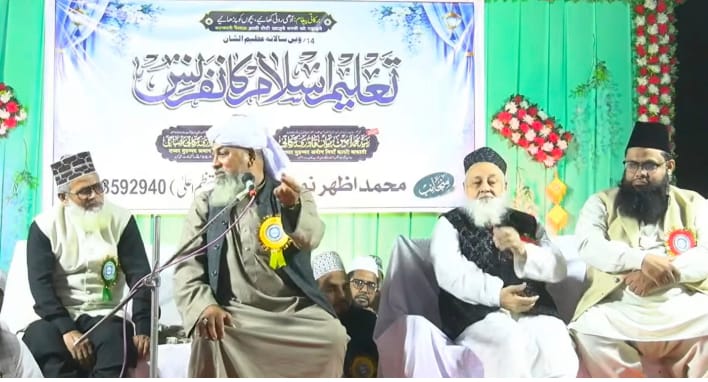
Report: S. Muneer
At a time when materialism, moral decline, the growing prevalence of intoxicants and the negative effects of social media have posed serious challenges to the intellectual and moral future of the younger generation, the need to reform society in the light of religious teachings, belief in the Hereafter and the Seerat-un-Nabi has become greater than ever. With this objective, the 14th Annual All India Taleem-e-Islam Conference was organised on Kolkata Market Road, opposite Jamalpur Eidgah. Scholars and spiritual personalities from different parts of the country attended the conference and, through their addresses, conveyed the message of protecting faith, awakening religious awareness, saving young people from intoxicants, and promoting moral and social reform in society. Special emphasis was laid on the fact that adherence to Islamic teachings and the promotion of religious values are essential for the intellectual and practical upbringing of the younger generation.
The conference was held under the patronage of Professor Al-Haj Al-Shah Syed Mohammad Amin Mian Qadri Barkati, Sajjada Nashin of Astana-e-Aaliya Qadriya Barkatiya, Marehra. The proceedings were presided over by Allama Maulana Shah Syed Mohammad Aman Mian Qadri Barkati Misbahi. The programme was jointly conducted by Maulana Nazim Raza Usmani (Bareilly Sharif) and Arif Raza Gauhar (Aligarh). The conference began with the recitation of the Holy Quran by Hafiz and Qari Javed Barkati. Thereafter, renowned Naat reciters Mustaqeem Raza Badauni, Mahkash Rampuri, Syed Furqan Ali Qadri and Abdul Muttalib, among others, presented devotional poetry in praise of the Prophet, earning appreciation and applause from the audience.
Mufti Abdul Mustafa Misbahi, who had arrived from Nepal, said in his address that belief in the Hereafter is the fundamental basis whose message was conveyed by all the prophets, from Prophet Adam to the final Prophet. Expressing concern over the evils spreading through social media, he urged people to follow four fundamental practices to safeguard their faith. These include teaching children the basic commandments of Islam and Iman-e-Mujmal and Iman-e-Mufassal, observing regularity in offering prayers, maintaining a strong connection with the Holy Quran, and reciting Durood and Istighfar frequently.
Maulana Tauseef Raza Misbahi, who had come from Sambhal (Moradabad), identified substance abuse as one of the major causes behind the increasing incidence of crime in society. He said that alcohol and other intoxicants are being introduced among young people under different new names nowadays. These substances are not only forbidden in Islam but are also causing damage to human health and the destruction of future generations. He urged students and the public to stay away from harmful products such as cigarettes and gutka, plant as many trees as possible, and earn their livelihood through lawful means.
Mufti Ishaq Ashfaqi, who had arrived from Haryana, spoke about the importance of religion in the light of the Quran and Hadith and referred to the historical incident of Mount Faran. He said that the titles of Sadiq and Amin were given to the Prophet himself by the disbelievers and polytheists. Explaining the principles of Islamic jurisprudence, he stated that, fundamentally, everything is permissible and lawful, except those things that have been declared forbidden or prohibited in the Quran and Hadith.
In his address, the chief patron of the gathering, Huzoor Amin-e-Millat, emphasised that meaningful gatherings on the subjects of Seerat-un-Nabi and Milad-un-Nabi should continue to be organised regularly. He congratulated the convener of the conference, Azizam Azhar Noor Azmi, appreciated his religious and preaching services, which he has been rendering for the past 14 years, and prayed for his continued enthusiasm and determination.
At the conclusion of the gathering, Salat-o-Salam was recited. This was followed by a special prayer for peace, progress and security in the country, marking the conclusion of the conference. On this occasion, a large number of people were present, including imams of mosques in Aligarh and nearby areas, teachers of madrasas, faculty members of Aligarh Muslim University, and people who had travelled from distant places.