Report: Shozab Muneer
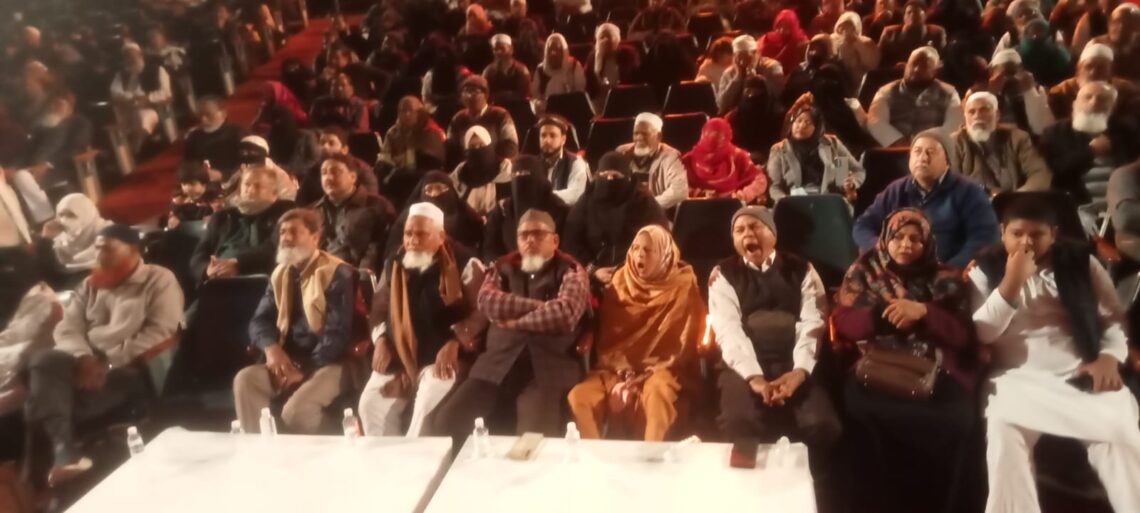
Aligarh: Under the supervision of the UP State Hajj Committee, Lucknow, and the Hajj Committee of India, Mumbai, a Hajj training camp was organized at the historic Kennedy Hall of Aligarh Muslim University.
Addressing the pilgrims, Pir Tariqat Dr. Mohammad Abbas Niazi said that Hajj is one of the five fundamental pillars of Islam, a great obligation that every financially and physically able Muslim must perform at least once in their lifetime. Hajj is a significant and blessed act of worship, encompassing physical, financial, and spiritual sacrifices. He stated that Hajj is not only the fulfillment of the Hajj obligation but also an expression of divine love. He emphasized that every Muslim must be knowledgeable not only about the Kalima, Salah, fasting, and Zakat, but also about the fifth pillar of Islam—Hajj—regardless of whether they are currently capable of performing it.
He explained that Hajj is a combination of financial and physical worship. In a short period, a pilgrim must temporarily set aside worldly affairs and wholly devote themselves to Allah. Leaving behind home, wealth, and family, and performing certain Hajj rituals in the prescribed Ihram while performing others in regular attire constitutes Hajj. Knowing the rituals of Hajj and Umrah is beneficial for a pilgrim and fulfills the guidance of the Prophet (PBUH).
He further explained that in earlier times, when modern travel facilities were unavailable, caravans learned the Hajj rituals on the way. Sea journeys used to last almost a week, providing opportunities to learn and teach during the trip. Today, with sea travel no longer common, pilgrims reach Jeddah by plane in just a few hours, making it difficult—almost impossible—to learn the Hajj and Umrah rituals in such a short time. Therefore, attending a Hajj training camp is essential. Scholars have historically taken the responsibility of training pilgrims, and now contemporary scholars, concerned pilgrims, and certain Hajj organizations contribute selflessly to this effort. As a result, both educated and uneducated pilgrims, including those who cannot read Hajj books or know other languages besides their mother tongue, benefit from these camps. Audio-visual methods, models, charts, maps, and pictures enhance understanding, making training more effective. Hence, pilgrims must participate in Hajj training camps.
Imam-e-Jummah of AMU, Syed Zahid Hussain, elaborated on Hajj and its rituals, emphasizing performing the journey purposefully to seek Allah’s pleasure. He stated that Hajj washes away sins, but its preservation is our responsibility. After Hajj, one should maintain its benefits throughout life, making it a means to earn Allah’s pleasure and success in the Hereafter. He advised pilgrims to utilize every moment of Hajj rather than let it pass amid distractions. From the moment a pilgrim intends Hajj, they enter into its sacred process, so their focus should be on maximizing its spiritual benefit. He added that no act in Islam, including Hajj, is merely ceremonial; it carries a higher purpose. Therefore, while performing Tawaf of the Kaaba, pilgrims should intend to revolve around Allah and His will in life. Similarly, while performing Sa’i between Safa and Marwah, pilgrims should aim to propagate and establish the faith in their homeland. From the ritual of Rami Jamraat, they should learn to overcome inner and outer evil inclinations.
Addressing the pilgrims, Master Hajj Trainer Shariq Alvi stated that Hajj training camps are extremely important. Pilgrims receive practical and theoretical training in all Hajj rituals, including how to wear the Ihram, perform Tawaf, Sa’i, standing at Arafah, rituals at Muzdalifah and Mina, and Rami Jamraat. They are also taught how to deal with challenges during Hajj, such as crowd management, heat, and long journeys. The training emphasizes health and hygiene, discipline, patience, endurance, and mutual cooperation. Pilgrims are also informed about actions to avoid, which could invalidate or spoil Hajj. The training builds confidence, enabling pilgrims to perform rituals without confusion. In short, Hajj training camps prepare pilgrims spiritually, physically, and practically so they can complete this sacred journey correctly, with sincerity and devotion.
On this occasion, Dr. Mufti Mohammad Amir Samdani, Dr. S. Javed Akhtar, Khalid Masood (former President of AMU Students’ Union), Haji Mohammad Najm, Dr. Faizan Ahmad (Senior Hajj Trainer), Haji Zaheer Khan, Nadhi Goswami (DMO), Rahat Sultan, Dr. Sharad Gupta (ACMO), and a large number of pilgrims were present. Hajj Trainer Moinuddin informed that this year, 430 pilgrims from Aligarh district will depart for Hajj.