
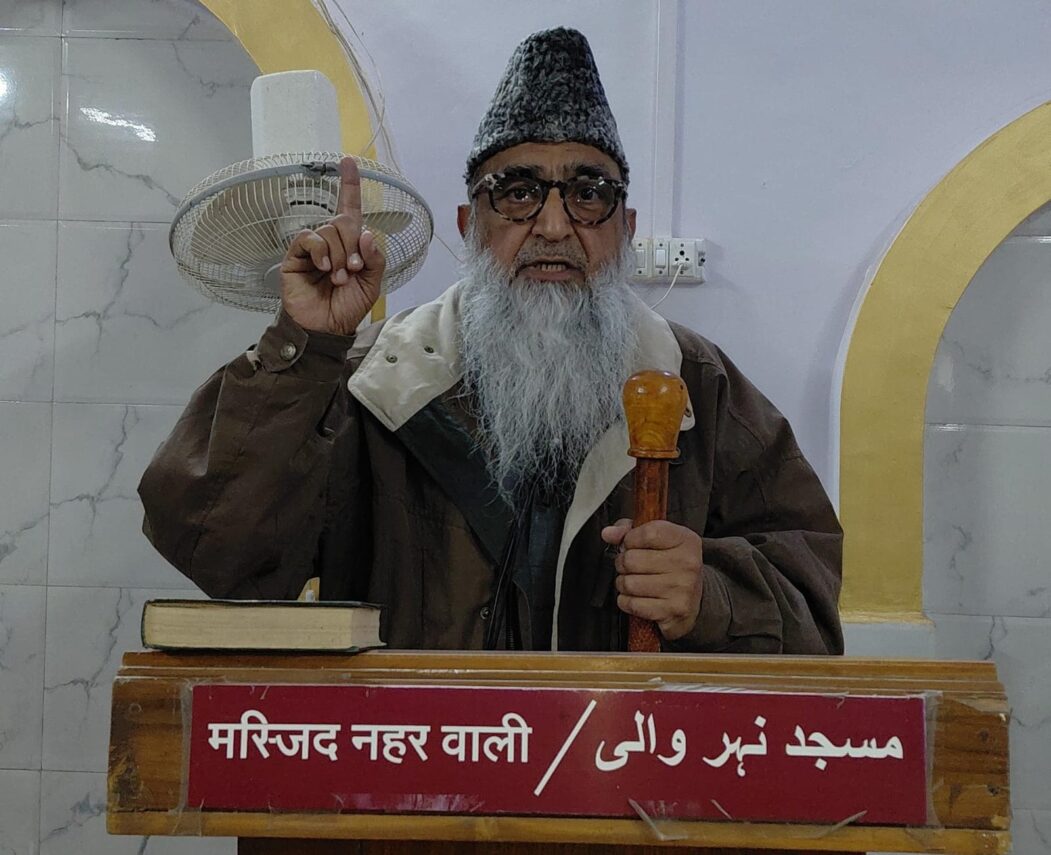
Agra: Muhammad Iqbal, the Khateeb of Masjid Nahar Wali located in the Sikandra area of Agra, delivered a powerful message of national unity and mutual brotherhood during his Friday khutba (sermon). Addressing the worshippers, he said that all people living in India are part of one single “nation (qaum)” because they share the same homeland.
Citing verses from the Holy Qur’an, Maulana Iqbal referred to Surah Al-A‘raf, explaining that several Prophets, including Hazrat Nuh (peace be upon him), addressed their people using the words “Ya Qaumi” (O my people). He pointed out that verses 61, 67, 79, and 85 of Surah Al-A‘raf show different Prophets addressing their respective communities in this manner, making it clear that the concept of qaum is not limited to religion alone.
Iqbal further explained that in today’s times, when a Muslim, Hindu, Christian, Sikh, Buddhist, or Jain applies for a passport, everyone writes “Indian” in the nationality column. On this basis, followers of all religions together form one Indian nation. He asserted with conviction that when the homeland is one, Hindus and Muslims are also one nation.
Quoting a Muslim scholar, Maulana Iqbal mentioned a note written years ago in the scholar’s diary:
“If ever a Muslim country and India were to face each other on a battlefield, my heart would wish for India to emerge victorious.”
He said that this very spirit still lives in the hearts of every sincere Indian Muslim today.
Highlighting the rich tradition of Hindu-Muslim unity, Iqbal said that countless examples exist in society, and many people associate their childhood memories with Hindu-Muslim friendship. He emphasized that the Ganga-Jamuni Tehzeeb is the true identity and pride of the nation, symbolizing harmony named after the great rivers Ganga and Yamuna.
Expressing concern over the present situation, he said that the disturbing atmosphere visible today is the result of the narrow thinking of only a handful of people. He stressed that all sections of society must come together to counter such divisive tendencies so that the spirit of Ganga-Jamuni culture can once again prevail.
Concluding his sermon, Muhammad Iqbal appealed to people to remove mutual misunderstandings themselves, increase social interaction, and stand by each other in times of joy and sorrow. He said that the greatest need of the present time is brotherhood, love, and national unity.