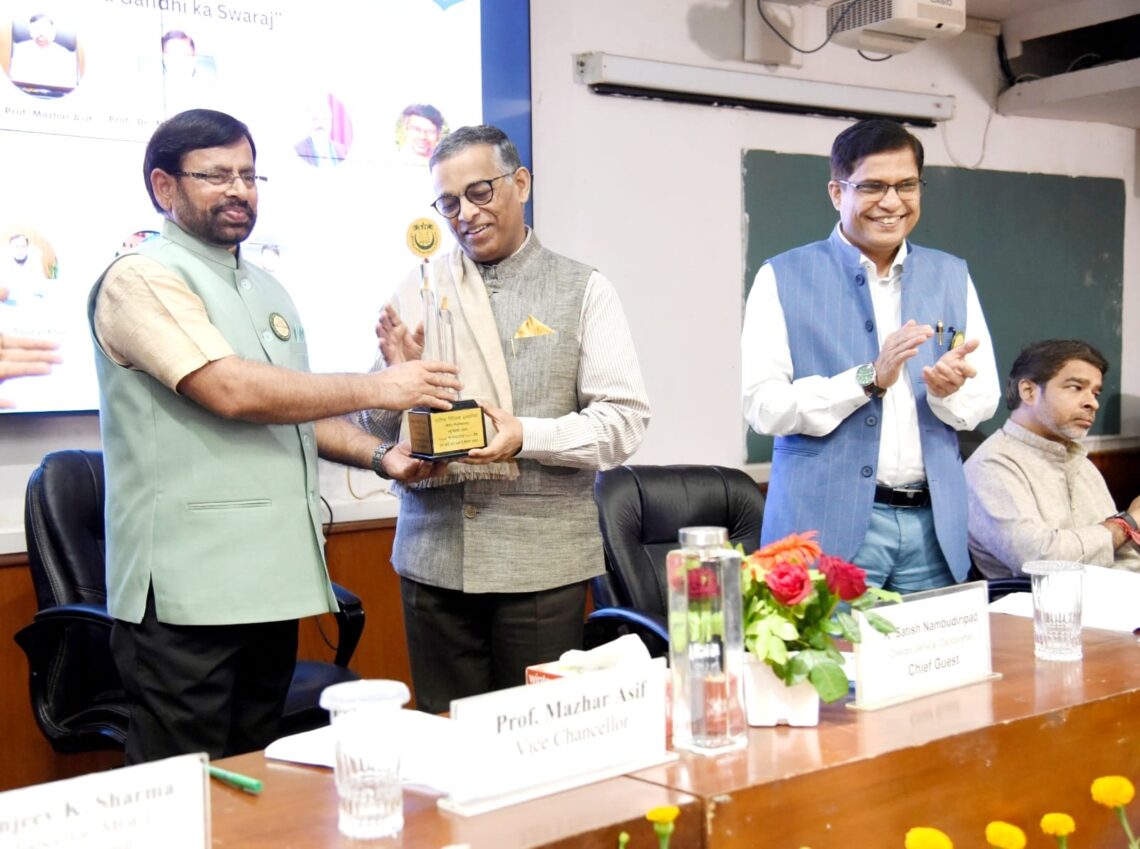
Doordarshan DG K. Satish Nambudiripad attends as Chief Guest; Prof. Mazhar Asif emphasizes living Gandhi’s ideals
New Delhi, Jamia Millia Islamia celebrated its 105th Foundation Day with a special symposium organized by the Nelson Mandela Centre for Peace and Conflict Resolution. The event focused on the theme “Mahatma Gandhi’s Swaraj”, highlighting the enduring relevance of Gandhi’s philosophy in contemporary society.
K. Satish Nambudiripad, Director General of Doordarshan, attended as the Chief Guest, while Prof. Mazhar Asif, Vice Chancellor of Jamia Millia Islamia, presided over the proceedings. Eminent scholars and academics shared insights on Gandhi’s vision and its application in modern India.
🔹 Swaraj as Self-Discipline and Morality
Addressing the gathering, Nambudiripad described it as an honor to speak at a historic institution like Jamia. “Jamia is not just a university,” he said, “it is a living symbol of India’s modern history, culture, progress, and aspirations.”
He emphasized that “Swaraj is not merely political freedom but a manifestation of self-discipline, morality, and collective welfare.” Quoting Gandhi, he added, “There is enough in this world for everyone’s need, but not for anyone’s greed.”
Reflecting on his tenure as Member Secretary of the National Council for Rural Institutes (NCRI), he recalled interactions with Gandhian thinkers Narayan Desai and Dr. Sudarshan Iyengar in Wardha, emphasizing that true Swaraj lies in balanced rural prosperity and humane coexistence. He also highlighted Gandhi’s moral guidance in navigating dilemmas such as idealism versus realism, development versus contentment, and urbanization versus rustic simplicity.
🔹 Living Gandhi
Presiding over the symposium, Prof. Mazhar Asif said, “The world knows Gandhi by reading or listening to him, but I live Gandhi — I am from Champaran, where his Satyagraha began.”
Prof. Asif drew parallels between Gandhi and Chanakya, noting how both transformed personal indignation into instruments of social reform. He recalled Gandhi’s simplicity, highlighting that after witnessing India’s poverty, the Mahatma lived in a single piece of cloth and remained a key supporter of Jamia Millia Islamia. During a financial crisis at the university, Gandhi reportedly said, “Jamia must continue, even if I have to beg for it.” He also noted that Gandhi’s son had taught at the university in its early years.
🔹 Perspectives from Other Speakers
Registrar Prof. Mohammad Mahtab Alam Rizvi praised the Nelson Mandela Centre for embodying Gandhi’s principles and emphasized that India can achieve true self-reliance by following the vision of Swaraj.
Dean of Students’ Welfare Prof. Neelofar Afzal highlighted Gandhi’s philosophy of “Taleem, Tahzeeb, and Tabiyat,” describing it as the soul of Jamia. Former Vice Chancellor of Mahatma Gandhi Central University, Motihari, Prof. Sanjeev Kumar Sharma, stressed the challenges of truly embodying Gandhi, noting his generosity and respect for critics. Prof. Sanjeev Kumar from Delhi University called for reinterpreting Gandhi’s Swaraj in today’s context.
🔹 Opening and Conclusion
The event opened with a recitation from the Holy Quran, followed by a rendition of the Jamia Tarana by students. The proceedings were conducted by Dr. Binish Maryam, with Co-convener Sudhanshu Trivedi delivering the welcome address.
The symposium concluded with a reaffirmation of Gandhi’s timeless message: “Swaraj is not merely political governance, but a moral and spiritual discipline — self-rule within.”