

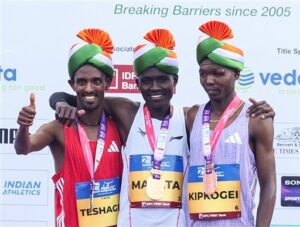
Matata, who had finished as runner-up last year behind Ugandan Joshua Cheptegei, executed a well-planned solo strategy to claim the men’s crown. Having already recorded a personal best of 59:20 at the RAK Half Marathon earlier this year, Matata carried significant experience with seven sub-60-minute half-marathons, including 59:53 from Delhi in 2024.

Alongside his teammate Reuben Rono, Matata completed the first 10K in 28:43, closely followed by six other runners. In the second half of the race, he broke away decisively from the field, running alone with no challenge to push for the course record of 58:53. He ultimately finished in 59:50, marking his fifth half-marathon victory this year. Ethiopia’s Bayelign Teshager secured second place in 60:22, while Kenyan James Kipkogei took third at 60:25. Pre-race favourite Birhanu Legese finished fourth with 60:54.
“I’m very thrilled about the race. Last year I was second, so my goal was to do better this time. I know the course, which was an advantage, and the weather was favourable with a cool start. At the 10K mark, I felt confident about winning. The course record wasn’t on my mind; the only objective was to win, and I ran without pressure, unlike last year,” Matata said after his victory.
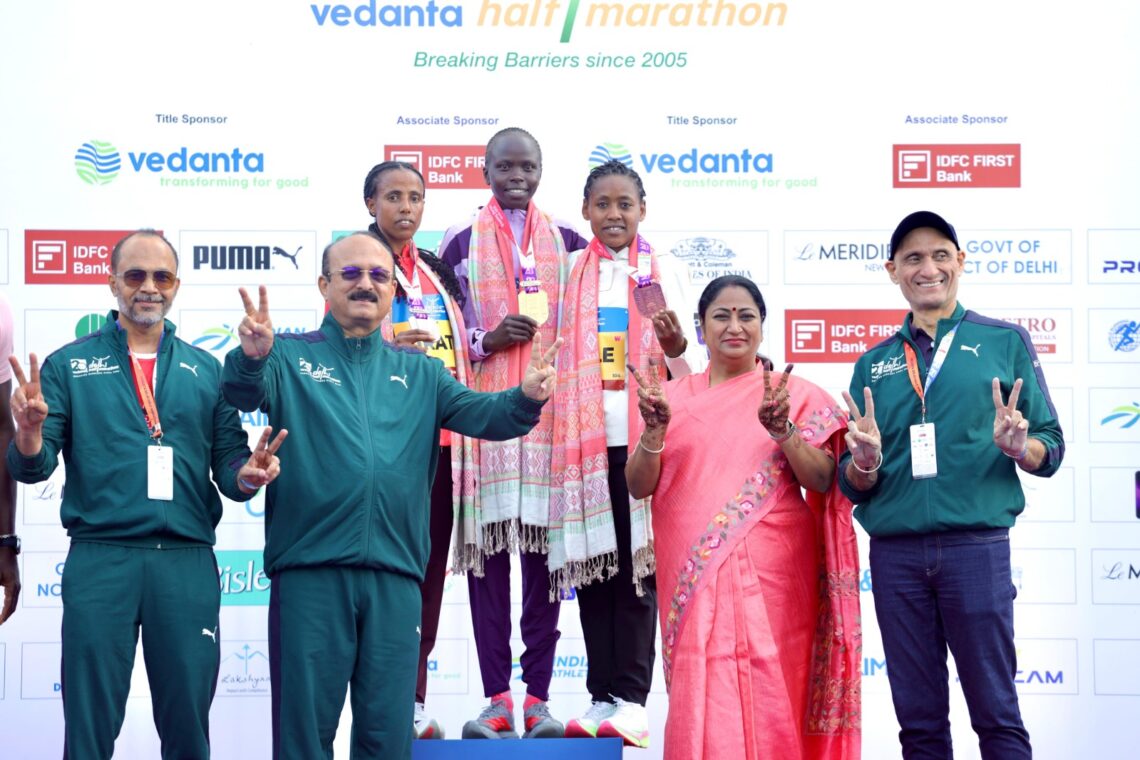
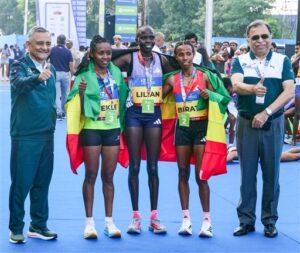
The women’s race unfolded differently, with Rengeruk adopting a strategic pack approach. For most of the race, she ran alongside a group of six runners, including Ethiopians Mulat Tekle and Melal Biratu. The trio passed the 10K mark in 32:10, slightly ahead of others, and were later joined briefly by Kenya’s 2023 World Half-Marathon bronze medallist Catherine Amangole. The group reached 15K together in 48:11, but Amangole could not maintain her pace as the finish approached near Jawaharlal Nehru Stadium.
In a thrilling sprint to the finish, Rengeruk overtook the young Melal Biratu, who was leading at the final stretch, to win the race in 1:07:20, just a second ahead of the Ethiopian. Tekle completed the podium eight seconds later, while last year’s winner Alemaddis Eyayu finished seventh in 1:10:51.
“The race was tough, and everyone was strong. I focused on doing my best and staying patient. I had the strength to push through, and I’m happy with my time, especially coming back from an injury. This was my third race of the year, and my strategy was to stay composed, take the lead when possible, and fight till the end,” Rengeruk said after her victory.
Melal Biratu, making her debut at this distance, said, “I’m delighted to set a personal best here in Delhi. This is my second time in India, and competing here is a great experience. The humidity was higher than expected, so I really had to push myself.”
The winners received US$ 27,000 each from the total prize purse of US$ 260,000.
Indian Elite Runners Make Their Mark
Among Indian runners, Abhishek Pal and Seema stood out in the elite category, claiming the top honours with INR 4,00,000 each. Abhishek Pal clinched the men’s title with a time of 1:04:17, marking his third victory at the Vedanta Delhi Half Marathon. Seema impressed on her debut, dominating the women’s field with 1:11:23.
In the men’s race, Pal and Kiran Matre (1:04:57) ran neck-and-neck for much of the distance, clocking 33:16 at the 10K mark and 43:58 at 15K. Pal eventually pulled away in the final stretch to secure the win. Mohd Aleem (1:05:20) and Manoj Kumar (1:05:25) were closely behind, while Kartik Karkera finished in bronze.
Seema steadily increased her lead as the women’s race progressed, finishing comfortably ahead. Ujala claimed second place with 1:15:41, narrowly ahead of Sanjivani Jadhav (1:15:52). Defending champion Lili Das finished fourth with 1:16:27.
Reflecting on his win, Abhishek Pal said, “I feel very good. The road was excellent, completely flat and straight. My brother, now my coach, guided me on race strategy. People said I usually run from behind, but today I led from the start and ran solo. We’ll focus on improving my timing and training further.”
Seema, meanwhile, expressed optimism despite missing the record, “I’m happy with my performance given my training. With proper preparation over the next two to three months, I believe I can perform even better in the future.”