
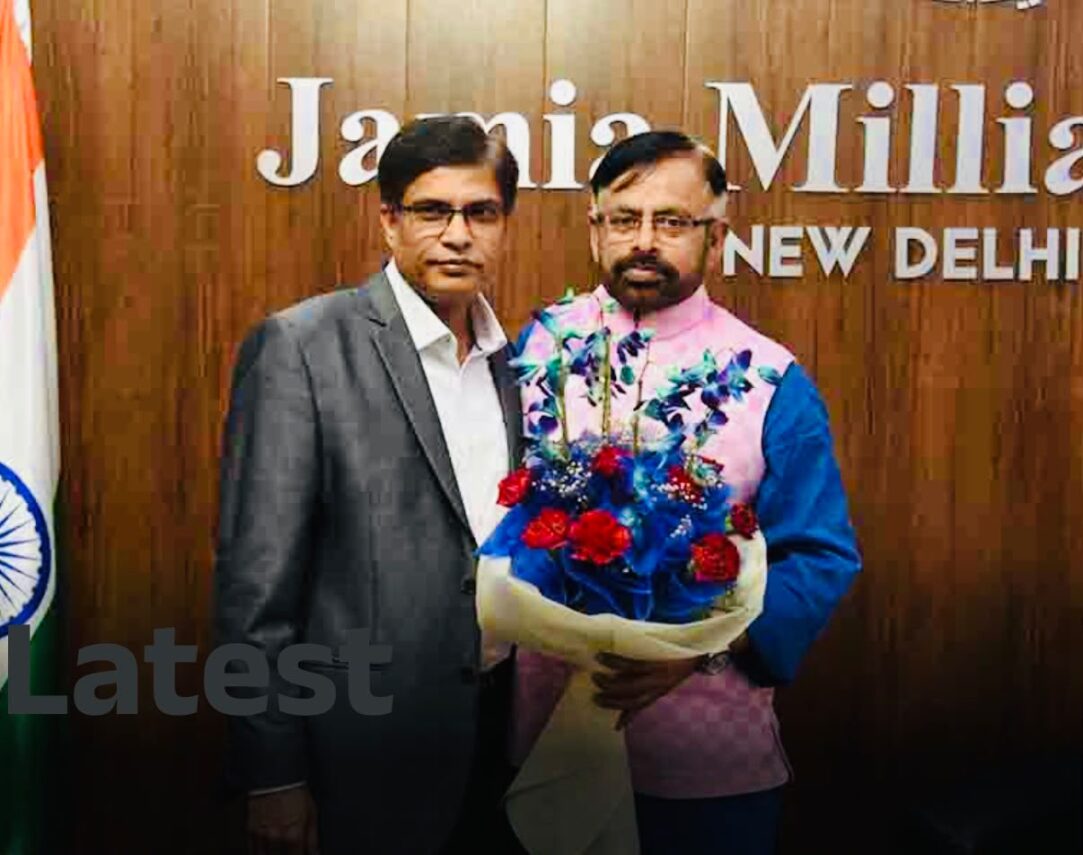
When a university goes through a phase of metamorphosis, the contribution of its administrative leadership becomes as important as its academic vision. At Jamia Millia Islamia (JMI), the present phase of administrative and institutional momentum is being witnessed under the leadership of Vice-Chancellor Prof Mazhar Asif, a distinguished academic associated with Jawaharlal Nehru University. One of the most important decisions taken by the Vice-Chancellor Prof Asif was to entrust the crucial responsibility of Registrar to Prof Md Mahtab Alam Rizvi.
That choice has acquired considerable significance with the passage of time.
Prof Mahtab Alam Rizvi, who has been serving as Registrar of JMI since November 2024, is not a traditional administrator who entered university administration after a purely bureaucratic career. He is an accomplished academic, researcher and scholar of international relations, strategic studies, West Asian affairs, peace and conflict resolution and energy security. Before assuming the responsibility of Registrar, he served as Professor and Director of the Nelson Mandela Centre for Peace and Conflict Resolution at JMI. His academic career has also included association with the Manohar Parrikar Institute for Defense Studies and Analyses (MPIDSA), an autonomous think tank under the Ministry of Defense, Government of India. JMI’s official profile records his extensive research, publications and academic engagements.
It is perhaps this combination of scholarship, institutional experience and administrative capability that makes Prof Rizvi particularly suited to the demanding office of Registrar.
An administrator with an academic mind
The office of Registrar is one of the most demanding positions in a university. The Registrar is required to coordinate a vast range of administrative, academic and statutory matters while simultaneously dealing with teachers, officers, non-teaching employees and students.
At a Central University like Jamia Millia Islamia, the responsibility becomes even more complex. Thousands of students, hundreds of teachers, numerous departments and centres, statutory bodies, examinations, admissions, appointments, promotions, service matters, infrastructure and financial procedures all require constant coordination.
Prof Mahtab Alam Rizvi’s academic background gives him an advantage in understanding these complexities. His profile reflects a career built around research, teaching, academic administration and policy-oriented scholarship. He has worked extensively on international relations and strategic affairs, particularly India’s relations with West Asia and Iran, and has participated in numerous academic and policy forums.
His appointment as Registrar therefore represents an interesting combination: an academic entrusted with the responsibility of managing one of India’s historic Central Universities.
Turning responsibility into results
Since assuming charge, Prof Rizvi has been associated with a period in which several long-pending and important administrative matters at JMI have received attention.
The Registrar’s office has a central role in matters concerning recruitment, promotions, service conditions, statutory bodies, institutional coordination and implementation of decisions of the university authorities. In a university of Jamia’s size, progress in these areas requires not merely decisions but sustained follow-up and coordination.
The significance of Prof Rizvi’s role can therefore be understood from the fact that his office functions as a bridge between the university’s academic vision and its administrative implementation.
The importance of timely administration
One of the most important characteristics of effective university administration is the ability to dispose of matters within a reasonable timeframe.
For a teacher awaiting promotion, an employee awaiting a service-related decision, a student waiting for a certificate or a department waiting for an administrative approval, a file is not merely a file. It can have a direct impact on a person’s academic or professional life.
This is where the personality and working style of a Registrar matter greatly.
Prof Mahtab Alam Rizvi’s responsibility has involved dealing with precisely such matters while maintaining coordination with different university offices. His academic orientation, coupled with his experience of working in a complex institution like JMI, has enabled him to approach administration with an understanding of the people behind institutional procedures.
This people-oriented dimension is important in an era when universities are increasingly expected to become transparent, responsive and student-friendly.
A key role in examinations and admissions
JMI’s examination and admission systems involve one of the largest administrative exercises undertaken by the university every year.
During the 2026 admission cycle, the university handled applications on a massive scale, while entrance examinations were conducted across several cities. The successful functioning of such a system requires close coordination between academic departments, examination authorities and the Registrar’s office.
The examination system has also seen significant activity under the present administrative framework. The university reported the successful completion of end-semester examinations covering more than 280 academic programmes, with around 25,000 students appearing for examinations, while hundreds of results were declared within the stipulated timeline.
The Registrar’s contribution here should be understood as part of the larger institutional mechanism rather than as an individual achievement. His responsibility is to ensure coordination and administrative support so that the concerned academic and examination authorities can perform effectively.
Supporting academic expansion
Another important dimension of Prof Rizvi’s tenure has been the university’s expansion into emerging academic areas.
JMI has been introducing new programmes in areas relevant to contemporary national and global requirements, including emerging technologies, renewable energy, biotechnology, social sciences, management and other disciplines.
Such expansion requires considerable administrative preparation. New programmes involve approvals, staffing, infrastructure, financial arrangements, admission procedures and coordination among various university authorities.
The Registrar’s office becomes the nerve centre through which many of these processes have to move.
Prof. Rizvi’s contribution is therefore not limited to conventional administrative work. It extends to creating the institutional conditions required for academic growth.
A bridge between academic and administrative leadership
Perhaps one of the most important qualities required of a Registrar is the ability to understand both sides of the university—academics and administration.
Prof Mahtab Alam Rizvi’s own career makes him particularly equipped for this role.
Having spent years as a teacher and researcher before taking up the Registrar’s responsibility, he understands the concerns of faculty members. At the same time, his present position requires him to work within the framework of university rules, regulations and statutory procedures.
This dual understanding can help reduce the traditional gap that sometimes exists between academic and administrative wings of universities.
His association with the Nelson Mandela Centre for Peace and Conflict Resolution is also significant. As its director, he had experience of academic leadership, research management and institutional coordination before taking over the Registrar’s office.
Building institutional partnerships
Prof Rizvi has also represented JMI in institutional collaborations and academic initiatives.
For instance, in connection with an MoU between JMI and the School of Planning and Architecture, Delhi, Prof Rizvi emphasised the importance of studies, seminars, training and joint research. The collaboration aimed at developing expertise in sustainable, resilient and low-carbon urban planning and design.
Such initiatives demonstrate that the Registrar’s role today is not confined to internal administration. Modern university administration increasingly requires engagement with other institutions, government bodies, professional organisations and international academic networks.
A scholar who understands the wider world
Prof Mahtab Alam Rizvi’s academic specialisation in international relations and strategic affairs adds another dimension to his administrative personality.
His research has focused on some of the most important geopolitical questions of contemporary times, including West Asian politics, India-Iran relations, energy security and peace and conflict resolution. His academic publications and participation in national and international forums have given him exposure to institutions and intellectual traditions beyond the conventional university environment.
This wider exposure is valuable for a university like JMI, which increasingly seeks to strengthen its international academic engagement and research profile.
The significance of the Vice-Chancellor’s choice
The fact that Prof Mazhar Asif chose Prof Md Mahtab Alam Rizvi for the office of Registrar is itself significant.
A Vice-Chancellor’s vision can succeed only when there is a competent administrative team capable of translating that vision into action. The Registrar is perhaps the most important link in that process.
Prof Rizvi’s performance should therefore also be viewed in the context of the confidence placed in him by the Vice-Chancellor, Prof Mazhar Asif.
Prof Rizvi was appointed Officiating Registrar in November 2024, and he continues to serve as Registrar.
The choice appears to have brought together academic experience and administrative responsibility at a crucial moment in Jamia’s institutional journey.
The road ahead
Jamia Millia Islamia has a remarkable legacy. Its historic identity, academic traditions and contribution to Indian education impose a special responsibility on those entrusted with its administration.
For Prof Md Mahtab Alam Rizvi, the challenge is therefore not merely to manage the university but to help it move forward while preserving its institutional character.
His journey from an academic and researcher to a senior university administrator demonstrates that scholarship and administration need not be separate domains. When an academic with research experience takes responsibility for administration, the university can potentially benefit from a broader understanding of institutional development.
The credit for this collective progress must finally be shared across the university. Vice-Chancellor Prof Mazhar Asif has provided the overall leadership and vision; Registrar Prof Md Mahtab Alam Rizvi has been entrusted with and is carrying the crucial responsibility of administrative coordination; Controller of Examinations Prof Ahteshamul Haque, Finance Officer Prof Md Kamalun Nabi, Dean Students’ Welfare Prof Neelofer Afzal, Chief Proctor Prof Asad Malik, all the Deans of Faculties, Heads of Departments, Directors of Centres, non-teaching staff and, above all, the students of Jamia Millia Islamia are integral to this institutional journey. Together, their collective efforts are contributing to a stronger, more efficient and academically vibrant Jamia Millia Islamia. ======================================
Prof (Dr) M Rahmatullah
AJK Mass Communication Research Centre,
Jamia Millia Islamia, New Delhi.
Mobile: 9818462389
Email: mrahmatullah@jmi.ac.in