
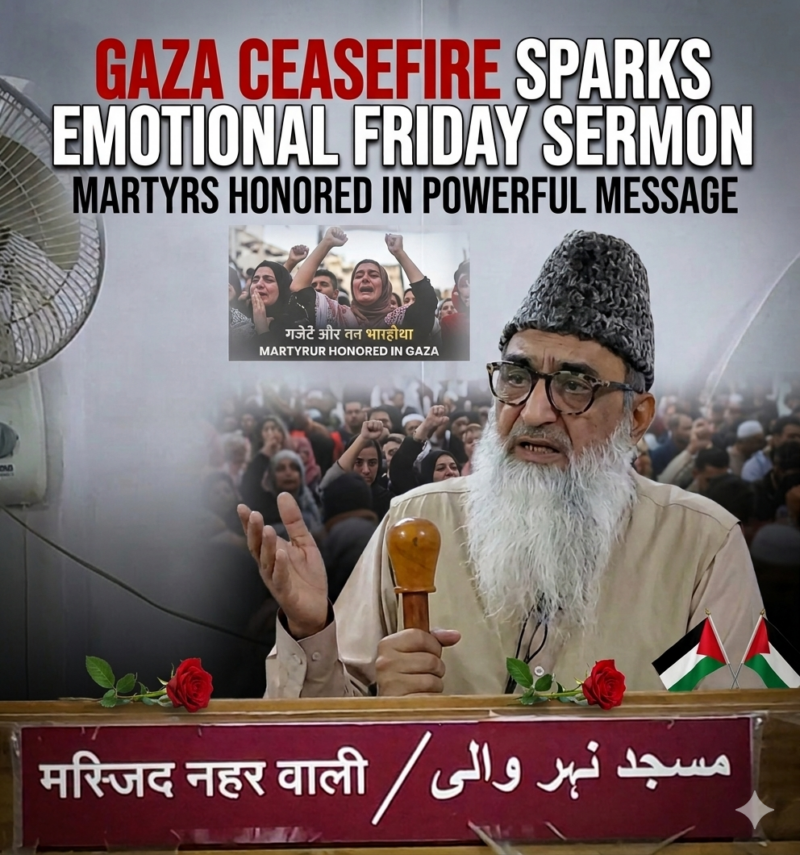
Agra: The Friday sermon at Masjid Nahar Wali, Sikandra witnessed a deeply moving address by cleric Maulana Mohammad Iqbal, who spoke at length on the situation in Gaza, the recent ceasefire, and the changing global dynamics. He paid heartfelt tribute to the martyrs of Gaza, stating that their sacrifices stand as a symbol of patience, resilience, and awakening for the Muslim community.
In his sermon, Maulana Iqbal said that after nearly forty days of intense and devastating conflict, the announcement of a ceasefire marks a significant turning point and can be seen as a step taken with wisdom. He emphasized that the conflict has exposed the true face of global powers and highlighted the far-reaching and destructive consequences of war.
He further noted that during this period, citizens in various countries also took to the streets against their own governments, expressing dissatisfaction—an indication of shifting public opinion at the global level.
Quoting the Holy Quran (Surah Al-Baqarah, Verse 249), he said:
“Many a time a small group has overcome a large group by the will of Allah, and Allah is with those who are patient.”
He explained that this verse resonates strongly with the present situation, where seemingly weaker groups showed remarkable patience and determination in the face of powerful adversaries.
Speaking on the devastation in Gaza, he said the images of destruction have shaken the world. He added that similar scenes are now being witnessed in opposing regions as well, describing it as a consequence of ظلم (oppression) and a reflection of divine justice.
Maulana Iqbal also referred to international legal developments, stating that global institutions holding Israeli leadership accountable indicate that the world is gradually recognizing the truth.
He praised Iran’s courage and steadfastness, noting that despite years of sanctions, the country demonstrated remarkable resolve, which can serve as an example for leadership across the Muslim world.
In his concluding remarks, he highlighted a positive development—that different sects within the Muslim community appeared united during this crisis. He stressed that if such unity continues, the community can face any challenge with strength.
He concluded with prayers for the martyrs of Gaza, asking for their forgiveness and elevated status, for the speedy recovery of the injured, and for unity, patience, and solidarity within the Muslim community. He also urged people to pray for the oppressed and to strengthen bonds of unity among themselves.