
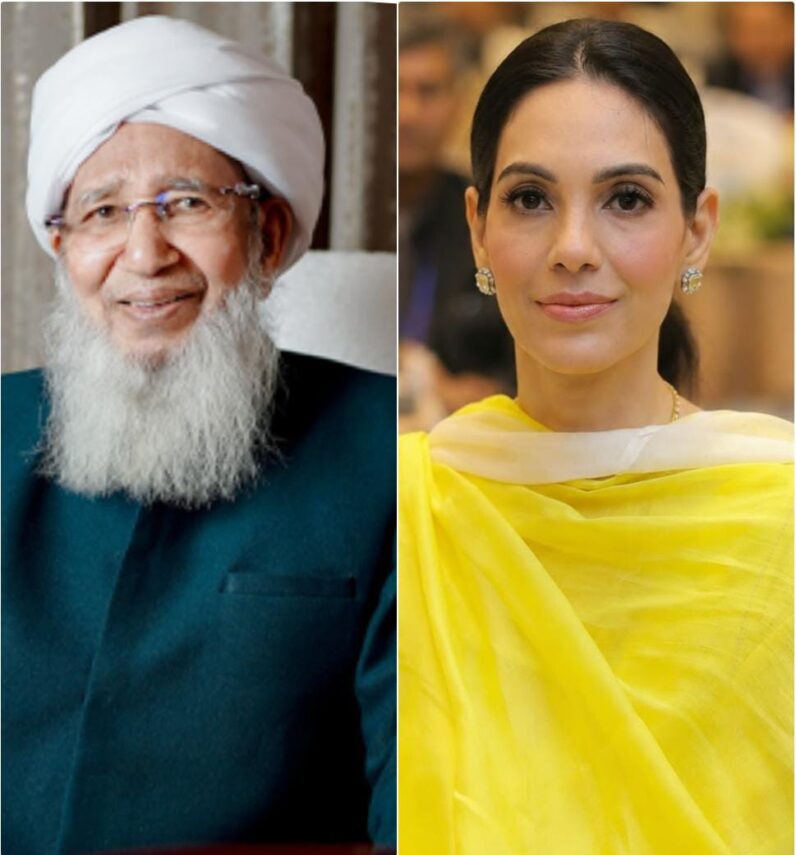
New Delhi | The remarks by Kerala Grand Mufti Sheikh Abubakr Ahmad, advocating that women should remain confined within the four walls of their homes, have sparked a sharp debate across the country. Speaking at a religious conference in Kochi, he said that women should stay at home and should not enter public life. Comparing women to gold jewellery, he argued that just as a gold necklace is kept in a box to protect its beauty and value, women too should remain at home. He described women entering public life as a cause of “great destruction” and linked the issue to the practice of purdah. Strongly opposing these remarks, Dr. Shalini Ali, National Convenor of the Muslim Rashtriya Manch and head of its women’s wing, said that confining women to their homes in the name of respect is not respect at all, but an attempt to place their freedom and capabilities under surveillance. She said that in a country where daughters are serving in all three branches of the armed forces, and are becoming scientists, doctors, engineers, economists, educators, journalists, pilots and athletes, advising them to remain confined at home is an insult to the reality of modern India.
Dr. Shalini Ali described the statement as highly objectionable and an example of an authoritarian mindset. She said a woman is neither a gold necklace nor a decorative object that can be locked away in a box. She is a free human being who lives with her dreams, talent, hard work and the right to make her own decisions. According to her, the mindset of keeping women confined within the four walls of the home instead of educating and empowering them is one that takes society backwards. She said in strong words that even an ignorant and uneducated person should not make such a statement, yet some so-called religious leaders want to keep women in ignorance and dependence rather than making them aware and equal citizens.
In his speech, the Grand Mufti said that women should remain at home and should not enter public life. Linking his argument to a religious interpretation, he said that the Quran gives such an instruction and that purdah has been prescribed to protect women’s dignity and safety. He also sought to clarify that his intention was not to demean women but to ensure their respect and protection. However, critics are asking: Can taking away someone’s freedom in the name of security really be called respect? Should a woman’s dignity depend on how far she remains removed from society and how confined her life is?
To explain his argument, the Grand Mufti used the example of a gold necklace. He said that at a jewellery shop, a gold necklace is taken out first from a cupboard, then from a box, and then from its packaging to be shown to a customer. He compared this with a stone-grinding machine kept by the roadside and said that if a gold necklace were placed on the road, passers-by could touch it, potentially affecting its beauty and value. Based on this analogy, he said that bringing women into public life could lead to “great destruction” and that this was the reason for the system of purdah.
This comparison has now become one of the most controversial aspects of the entire debate. The question being raised is: Why should a woman be compared to an inanimate piece of jewellery in the first place? A gold necklace may be the property of a jewellery shop, but a woman is the owner of her own life. She is not anyone’s possession; she is a citizen with rights. Her education, employment, career, participation in public life and ability to make decisions about her future cannot be taken away merely in the name of “security” or “respect.” This is the fundamental question at the heart of Dr. Shalini Ali’s objection.
Modern India has moved far beyond the old framework in which a woman’s entire identity was considered limited to the home and family. The country’s daughters are fighter pilots and scientists, doctors and engineers; they are present in universities and courts, journalism and industry, and are raising the Tricolour on sports fields. They are defending the country’s borders, working on challenging scientific projects, saving lives in hospitals and representing India on the global stage. In such an India, the idea of keeping women locked inside their homes does not merely restrict a woman’s aspirations; it appears to be an attempt to restrict the potential of half the country’s population.
Dr. Shalini Ali said in this context that Indian women are serving in all three branches of the armed forces to protect the nation. They are making their mark in science, medicine, engineering, sociology, economics, education, journalism, aviation and sports, among numerous other fields. According to her, women should not be viewed as weak; their capabilities should be trusted. A woman who can defend the country is certainly capable of making decisions about her own life.
In his speech, the Grand Mufti also said that religious scholars, particularly scholars associated with relevant Sunni religious organisations, have promoted this view for a long time and that it has helped preserve women’s “dignity.” Defending his authority to speak on the issue, he said that religious scholars have studied religion and therefore it is their duty to speak about religious matters. He also said that he would continue speaking on the issue and that no one could stop him.
In another part of his speech, he referred to the status of women in Islamic history and said that Islam stopped practices such as the killing of daughters and granted women rights to property and inheritance. His argument was that a system keeping women away from public life should also be viewed as a means of ensuring their respect and safety. In other words, his broader argument was that restrictions should be understood as protection and distance from public life should be regarded as respect.
But this is precisely the point on which the Muslim Rashtriya Manch’s objection is strongest. The organisation has stated that a woman’s dignity lies not in confinement but in her rights, independence and respect. If a woman wants to manage her home, that is her right; and if she wants to join the armed forces, become a doctor, pursue journalism, run a business or participate actively in public life, that is equally her right. The choice must belong to the woman—no other person can decide the course of her life on her behalf.
It is also important to understand that the Grand Mufti’s remarks should not be treated as the unanimous opinion of the entire Muslim community or all Muslim scholars. They represent the interpretation and viewpoint of one religious leader. Defining millions of people on the basis of one individual’s statement would be neither appropriate nor fair. Likewise, criticism of these remarks should not be turned into a campaign against any religion; it should instead be viewed as a question concerning women’s freedom, equality and rights.
Ultimately, the issue is very straightforward: Does a woman deserve respect or control? Security or confinement? Opportunity or four walls? The women of modern India have already answered these questions through their work and achievements. They do not need to prove that they are capable. They have established their place everywhere—from the armed forces to space, from hospitals to sports fields, and from schools to Parliament.
The strongest message emerging from this entire controversy is that India’s daughter is not a gold necklace to be locked inside a box in order to preserve her “value.” She is the architect of her own future. Families will become stronger, society will become stronger and the nation will become stronger not by confining women, but by enabling them to move forward. Whether it is the Grand Mufti’s “stay at home” viewpoint or any other mindset, in any community, that seeks to place women’s freedom under restriction—it deserves to be questioned. Because a woman’s freedom is not a favour granted by any religion, caste or community; it is her dignity and right as a citizen.