
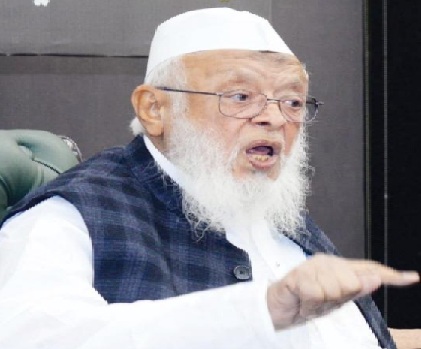
If the law is the same for everyone, why is there a double standard in its implementation? Bulldozers have now become a symbol not of justice, but of the politics of revenge, prejudice, and hatred: Maulana Arshad Madani
New Delhi: The President of Jamiat Ulama-i-Hind, Maulana Arshad Madani, has expressed deep anguish and regret over the demolition of an old mosque located within the Saharanpur Collectorate at around 5:00 a.m. He said that the incident has once again raised a fundamental question before the country: Is the Constitution and the law truly being implemented equally for every citizen and every religion?
If the Constitution guarantees equality, freedom of religion, and equal protection of the law to all, then why is such a double standard being witnessed in its practical implementation?
Maulana Madani said that the Saharanpur incident is not merely a matter concerning a mosque; rather, it is an extremely sensitive issue linked to the supremacy of the Constitution, the rule of law, religious freedom, equality of citizens, and the impartial role of the state.
He said that the Places of Worship Act, 1991, is still in force. The action taken by the administration is not only a violation of this Act, but also a clear violation of the provision relating to “Waqf by User” contained in the new Waqf law. Moreover, the mosque is registered with the Waqf Board under Registration No. 451.
He further pointed out that, importantly, the land has been recorded from the very beginning in the names of Yaqub Khan and Wahid Khan. Despite this, he questioned, “Where is the justice in taking such action?”
He also said, “If illegal occupation and encroachment are to be the sole criteria for taking action, then the same criteria must be applied equally to every religion and every section of society.”
However, through such pretexts and excuses, a particular community is being selectively targeted.
Maulana Madani also questioned that if religious structures have existed for years and even decades on government land, roads, public places, and other locations in different parts of the country, is the administration taking action against all such structures with the same haste, the same severity, and by applying the same standards?
If this is not the case, then the extraordinary harshness shown in the case of a particular religious site raises serious questions about the very principle of justice.
He said that any legal dispute concerning the ownership of a religious site or the land on which it stands can be resolved through the courts. However, the long-standing religious use of the site, historical records, and ground realities must also be examined with due seriousness within the framework of the law.
In this regard, the position of the mosque committee is also important. The committee had presented various historical documents before the court, showing that the mosque predates the present Collectorate building.
According to some reports, the mosque committee also presented documents dating back to 1911, municipal records, and old revenue entries before the court. However, these were allegedly ignored.
He went on to say that in such a situation, a fundamental question arises: If prayers have been offered continuously at a particular site for more than a century, if generations of people have used it as a mosque, and if documented claims regarding its antiquity also exist, then to what extent is it appropriate to view this entire historical reality merely as an administrative dispute?
Maulana Madani said: “This country does not belong to any one religion or any particular community. India is the shared homeland of Hindus, Muslims, Sikhs, Christians, and people of all religions and beliefs. The Constitution has not made anyone a first-class citizen and anyone else a second-class citizen. Then why does the conduct of the administration create an impression that religious identity is influencing the standards of justice?”
At the end Maulana Madani said that we are not asking the government for any special concession; we are only asking for equal justice. Our question is very straightforward: if the law applicable to a mosque is the same, why should it not be applicable to every religious place? If a particular standard is applied to a Muslim, why should the same standard not be applied to every other citizen? If the Constitution and the law are meant for everyone, then their protection and enforcement must also be equal for all.