
Report: S. Muneer
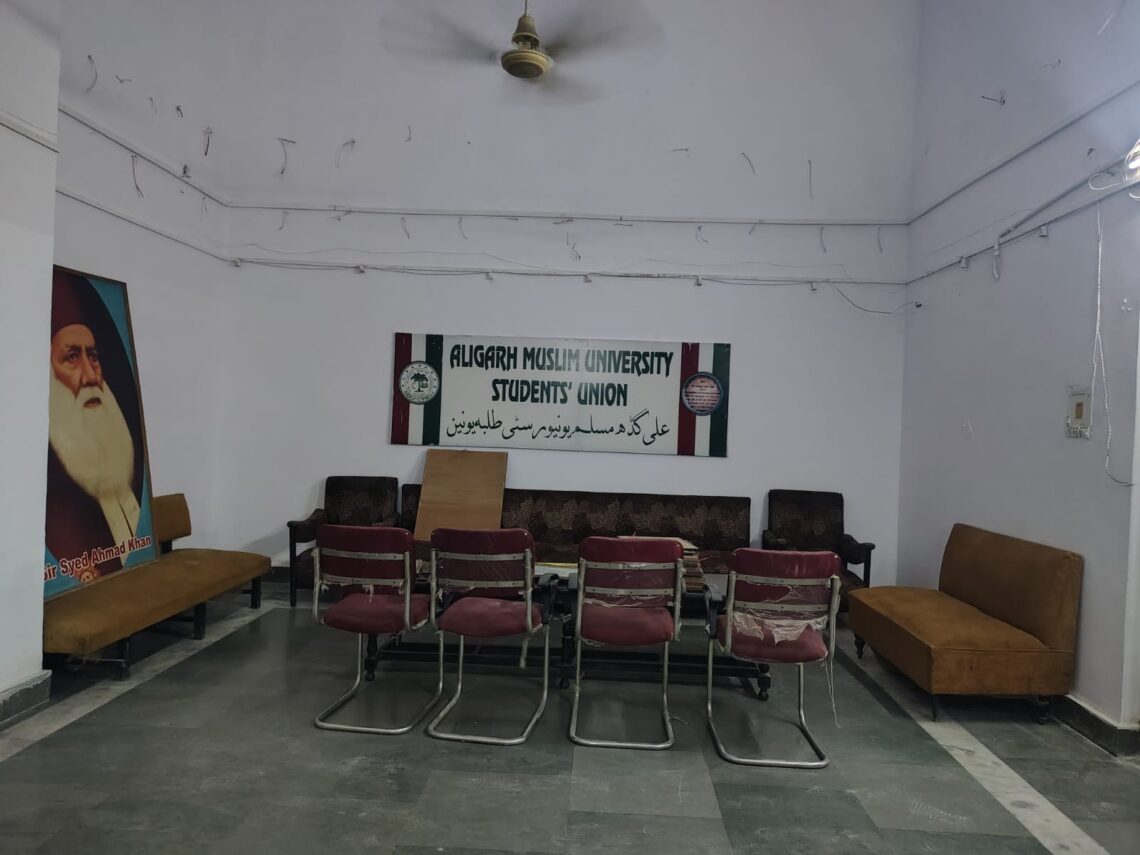
Aligarh: After a long gap of eight years, electoral activities have intensified at Aligarh Muslim University, and the election atmosphere has begun to heat up. Candidates have started preparing their strategies, and efforts to unite voters in their favour have also gathered pace. In this situation, the biggest question is whether the votes of students from the Faculty of Social Sciences and the Zakir Husain College of Engineering and Technology will once again determine the direction of the election results. Given the large number of voters in these two faculties, every candidate is focusing on them. On the other hand, ensuring security, along with conducting the elections peacefully, impartially and transparently, has also become an important issue. Former student and Advocate Syed Kaif Hasan, who practises at the Supreme Court, has made it clear that ensuring security during the elections is the responsibility of the university and district administrations, and compliance with the Supreme Court’s directions is mandatory.
Voters from the Faculties of Social Sciences and Engineering May Play a Decisive Role
As electoral activities have intensified at Aligarh Muslim University, political manoeuvring and electoral alignments have begun. In this election, students from the Faculty of Social Sciences and the Zakir Husain College of Engineering and Technology may determine the outcome. These two faculties have the largest number of voters, which is why every candidate is keeping an eye on them.
According to university sources, a total of 3,522 students are enrolled in AMU’s Faculty of Social Sciences, including undergraduate students, postgraduate students and research scholars. Thousands of students are also studying in the Faculty of Engineering. The number of voters from these two faculties on the electoral roll is higher than that of all other faculties. This is why these two faculties played a decisive role in the last Students’ Union elections held in 2018.
The last AMU Students’ Union elections were held in 2018. At that time, more than 20,000 students exercised their right to vote. Polling booths were set up in 14 university departments. The university administration spent Rs 3.46 lakh to conduct the elections peacefully and impartially. According to the figures, the voter turnout among students of Social Sciences and Engineering was the highest. The candidate who gained an advantage in these two faculties came closest to securing the post of president.
Expectation of One-Sided Voting
The situation is expected to remain similar this time as well. The Faculty of Social Sciences comprises 12 departments, where student politics remains quite active. Students discuss election-related activities every day in the canteen and library. Meanwhile, students of the Faculty of Engineering vote as a united group, which is why their vote bank is considered quite strong.
Senior student leaders say that in AMU Students’ Union elections, votes from the Arts, Science and other faculties get divided, whereas voters from Social Sciences and Technology tend to vote overwhelmingly in one direction. This is why candidates are first focusing on strengthening their support base in these two faculties. Election campaigning has also intensified on social media to attract students from these faculties.
Departments and Number of Voters (2018)
- Faculty of Agricultural Sciences and Theology — 416
- Faculty of Arts — 1,888
- Faculty of Engineering and Technology — 3,199
- University Polytechnic — 1,358
- Women’s Polytechnic — 454
- Faculty of Commerce — 916
- Faculty of Law — 618
- Faculty of Life Sciences — 696
- Faculty of Management and International Studies — 555
- Faculty of Medicine — 1,772
- Faculty of Science — 2,694
- Faculty of Social Sciences — 3,196
- Faculty of Unani Medicine — 426
- Women’s College — 2,741
Total voters: 20,929
Proposal for the Election Core Committee Sent to the Administration
The university administration has begun preparations for the AMU Students’ Union elections, which are being held after eight years. The election officer has sent a proposal for the core committee to the administration to ensure that the elections are conducted impartially. He said that in 2018, initially 76 members were included in the core committee. Subsequently, another 20 members were added. This year, a proposal to include more than 60 members has been sent.
Candidates May Get Relaxation in the Age Limit
Several student organisations have submitted applications to the Vice-Chancellor seeking relaxation in the age limit for the AMU Students’ Union elections. According to the election officer, a proposal for age relaxation is being prepared. If the core committee and the university administration approve it, candidates may also receive relaxation in the age limit.
Students’ Union May Get Its President on the Morning of November 6
The AMU Students’ Union election process will begin on October 26. Voting will take place in 14 departments on November 5, after which vote counting will begin at 7 p.m. The election officer said that voter turnout this year is expected to be between 22,000 and 24,000. As a result, counting may take considerable time. It is possible that counting will continue until morning. The AMU Students’ Union may receive its president and other office-bearers on the morning of November 6.
Ensuring Security During Elections Is the Responsibility of the University and District Administrations
Syed Kaif Hasan, a former student of Aligarh Muslim University and an advocate practising at the Supreme Court, has said that ensuring security during the AMU Students’ Union elections is the responsibility of the university administration and the district administration. Compliance with the Supreme Court’s directions is mandatory.
Compliance with the Supreme Court’s Order Is Essential,

Advocate Syed Kaif Hasan said that in its order dated September 22, 2006, the honourable Supreme Court accepted the recommendations of the Lyngdoh Committee and issued clear directions regarding the conduct of Students’ Union elections in all universities and colleges across the country. Under Article 141 of the Constitution, the law declared by the Supreme Court is binding on all courts and states in the country. Therefore, the relevant authorities should ensure compliance with judicial orders.
He further said that in the said order, the honourable Supreme Court recognised the need to protect the academic community involved in the Students’ Union election process. It directed the Senior Superintendent of Police (SSP) of the relevant area to deploy an adequate number of police personnel. Security should also be ensured near the polling venue, and any untoward incident should be prevented. The court had further clarified that these directions would apply to Students’ Union elections held in all universities and colleges across the country. The governments of all states and the Union Territories are required to ensure compliance with these directions.
He said that, in view of the forthcoming Students’ Union elections at Aligarh Muslim University, it is necessary to make it clear that maintaining security and law and order during the elections, and ensuring that the election process is completed peacefully and without interruption, are the responsibilities of the university administration and the district administration. The university administration should make the necessary arrangements related to the elections, while the district administration and police should ensure the deployment of an adequate security force in accordance with the Supreme Court’s directions.
Any potential concern or law-and-order challenge should be addressed through appropriate security arrangements, administrative coordination and timely action. Fulfilling security-related responsibilities is the duty of the relevant administrative authorities so that students can exercise their democratic rights and the election process can be completed in a fear-free environment.
Syed Kaif Hasan said, “I appeal to the university administration, district administration and the concerned police officers to ensure the necessary security arrangements for the forthcoming AMU Students’ Union elections in a timely manner and to comply with the honourable Supreme Court’s order dated September 22, 2006, word for word.”
Conducting Students’ Union elections peacefully, impartially and safely is not merely an administrative process for the university; it is also an important responsibility towards ensuring students’ democratic representation. The Supreme Court’s order cannot be cited as an excuse to evade holding elections in the name of security, because the court itself has placed the responsibility for security on the state government and the district administration.

In this regard, Chief Election Officer Professor Javed Talib said that conducting the Students’ Union elections peacefully, impartially and fairly, along with ensuring security, is among our priorities.