Shozab Muneer
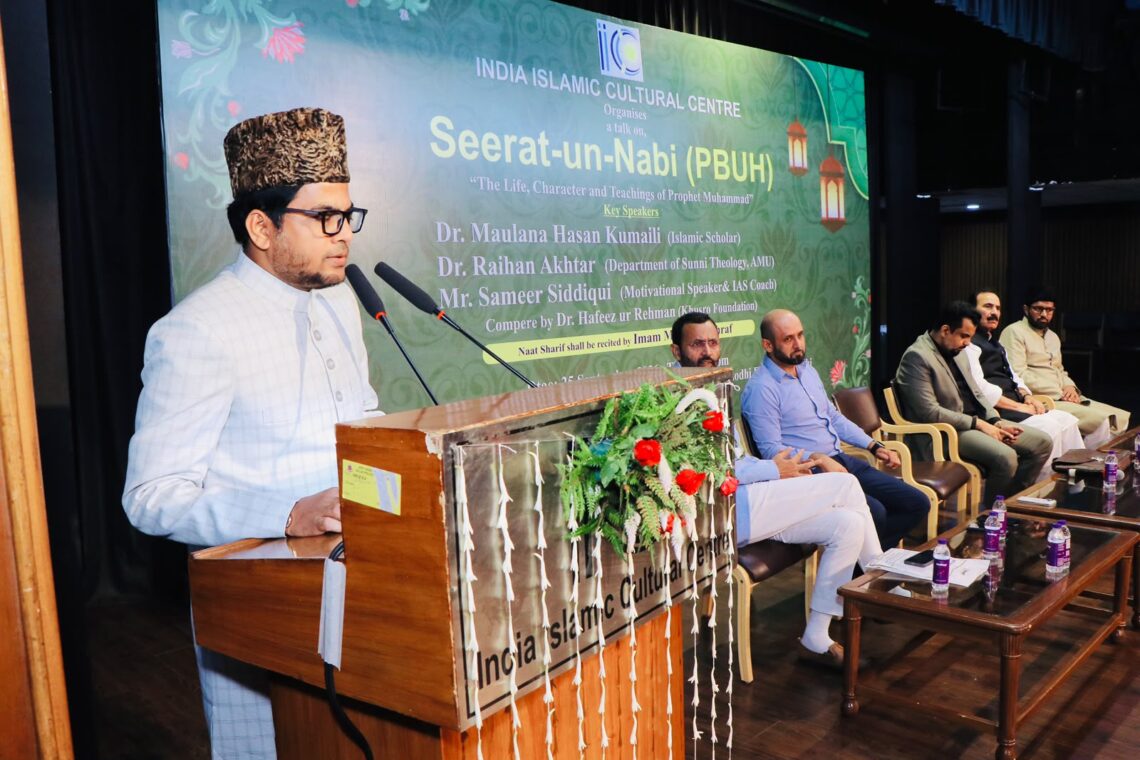
New Delhi: The life of the Prophet Muhammad is not merely a collection of historical events but a comprehensive guide for human life, Dr Rehan Akhtar, Assistant Professor at the Faculty of Theology, Aligarh Muslim University, said at an annual Seerat-un-Nabi programme held at the B. S. Abdur Rahman Auditorium of the India Islamic Cultural Centre on September 25.
Speaking on “Seerat-un-Nabi: The Blessed Life, Character and Teachings,” Dr Akhtar said the Prophetic teachings encompass faith and worship as well as morality, justice, human rights, social relations, tolerance and mutual respect. He said the Prophet began social reform by transforming individual character and gradually extended it to collective life.
Referring to the Quranic command to warn one’s nearest relatives, Dr Akhtar said the early phase of the Prophetic mission demonstrated that reform and goodwill begin with those closest to a person and gradually extend to the wider society.
He highlighted the Prophet’s emphasis on honesty, patience, good conduct and respect for human dignity. Citing the example of Hazrat Anas, who served the Prophet for ten years, he said the Prophet never treated him harshly. On one occasion, when Anas was delayed while carrying out an errand, the Prophet went to enquire about him and asked about the delay with a smile. Dr Akhtar described the incident as an example of a method of correction that respected a person’s dignity and emotions.
He also cited the well-known incident in which the Prophet stood in respect when a Jewish funeral passed by. When told that it was the funeral of a Jew, he asked, “Is it not a soul?” Dr Akhtar said the incident demonstrated respect for human life and dignity irrespective of religious differences. He also referred to the Prophet’s visit to a sick Jewish boy who used to serve him.
On women’s education, Dr Akhtar said the Prophet responded to women’s request for a separate time for learning by fixing a dedicated time for them. He added that the Prophetic teachings also emphasised the rights and dignity of women, children, orphans, the weak and the needy.
Dr Akhtar noted that the study of the Prophet’s life has attracted scholars and writers beyond the Muslim world, mentioning Annie Besant, Karen Armstrong, Bosworth Smith and Philip K. Hitti among others. He said the extensive scholarship on the subject in different languages reflects its wider intellectual significance.
Concluding, Dr Akhtar said Seerat-un-Nabi should not be confined to a particular day, month or gathering. Its essence, he said, lies in incorporating its values into daily life through patience in disagreement, justice in positions of authority, compassion towards the vulnerable and respect for fellow human beings.