Aligarh S. Muneer
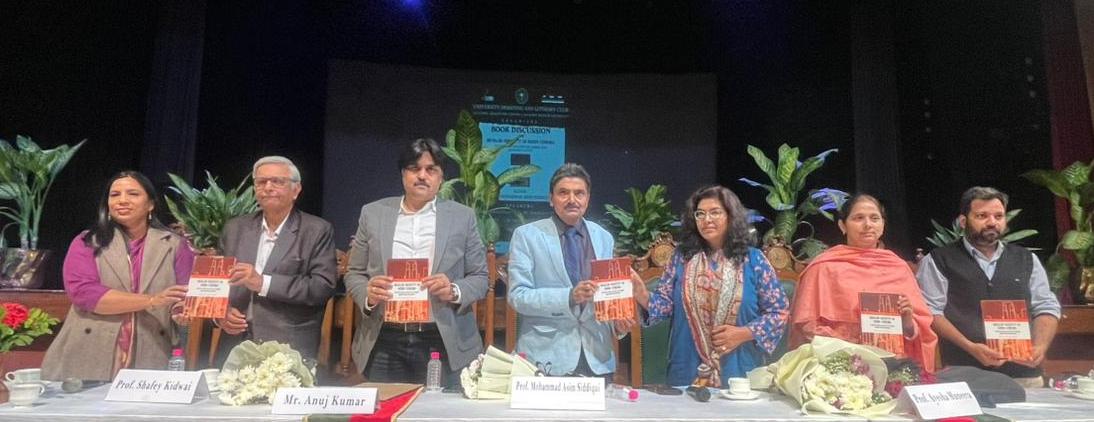
University Debating and Literary Club, Aligarh Muslim University (UDLC) organised a Book Discussion on Prof. Mohammad Asim Siddiqui’s Muslim Identity in Hindi Cinema: Poetics and Politics of Genre and Representation recently published by Routledge on 18th November, 2025 at Kennedy Auditorium. The session witnessed riveting discussion and reviews by The Hindu Deputy Editor, Mr. Anuj Kumar, Prof. Aysha Munira, Dr. Sunij Sharma and Dr. Adiba Faiyaz; chaired by Prof. Shafey Kidwai, Sahitya Akademi Awardee and former Dean, Faculty of Social Science. The event made a mark for eliciting an enthusiastic response not only by the young students and members of the Cultural Education Centre, but also by the University teachers and retired faculty.
Prof. Mohammad Naved Khan, Coordinator CEC and Prof. Nazia Hasan, President of the University Debating and Literary Club set the tone of the discourse with their welcome addresses, emphasising on the relevance of conversations about representation in today’s public discourse. Prof. Hasan pointed out how films have acquired the status of cultural texts and the need to decipher the politics of ‘seeing and being seen’ play a significant role in the contemporary image saturated age.
The main discussion opened with remarks by Dr. Adiba Faiyaz (Department of English, AMU) who traced the evolution of film genres shaped by social and economic conditions. She also commented on the writing style and the Postmodern textual aspects of the book.
Taking the discussion further, Dr. Sunij Sharma (Department of English, AMU) spoke about the lack of genre-related engagement within the Hindi film industry and the need to rethink how films are categorised. He noted that the book looks at films that have Muslim characters even when not made for Muslim audiences. With reference to Stuart Hall, Sharma explained that viewers interpret movies through oppositional, negotiated, or affirmative readings.
Prof. Aysha Munira reflected on the book’s tone and vocabulary, noting that identity is formed as much through shared similarities as through marked differences. She remarked that “this book is a panoramic view of the history of Indian cinema and is for people familiar with Hindi cinema”, highlighting the significant contribution of Prof. Siddiqui to the genre of Screen Studies.
The final speaker of the panel, Mr. Anuj Kumar (a film critic and the Deputy Editor The Hindu) discussed how earlier cinematic patterns continue to shape the present, including the rise of a ‘cinema of hate’ and the growing influence of propaganda films. He noted that these narratives do not remain confined to the screen; they shape public perception, and with time begin to influence political debates, policy choices, and even the basic facts accepted as truth by the society. He stressed that when such films normalise fear or distortion, they gradually shift the cultural baseline of what appears credible or acceptable.
Together, the panellists examined the book’s central arguments concerning identity and the shifting portrayal of Muslims in Hindi cinema. Their discussion drew attention to the ways film narratives shape public understanding and the significance of reading cinema as a cultural text.
The author, Prof. Mohammad Asim Siddiqui, Department of English, Aligarh Muslim University, reflected and appreciated the views of the panelists, and shed light on impulses and enquiries that shaped the book and urged the audience to take cinema seriously and not just as a source of entertainment.
Prof. Shafey Kidwai chaired the session and delivered the concluding comments. He underscored the scholarly value of the book and highlighted the need for continued engagement with film studies within university spaces. The book discussion concluded with a brief question-and-answer session, engaging the audience in an interactive dialogue. Ms. Sayed Aqsa, Ms. Madiha Naaz, Syed Faheem and Ms. Anusha Munawwar- members, UDLC conducted the event.