New Delhi, India’s civilizational ethos is intrinsically rooted in the idea of Vasudhaiva Kutumbakam—the world as one family—and global brotherhood is not a borrowed concept but an inbuilt value of Indian culture. These views were expressed by Prof. (Dr.) Mohammad Mehtab Alam Rizvi, Registrar of Jamia Millia Islamia, while addressing the valedictory session of the two-day 6th Himalaya–Indian Ocean Nations Group (HHRS) International Conference 2026, held at the Convention Centre of Jawaharlal Nehru University (JNU), New Delhi.
Presiding over the concluding session, Prof. Rizvi said that if societies adopt coexistence based on harmony, mutual respect, and cooperation, conflict and violence would naturally recede. Drawing an analogy from family relationships, he said that just as members of a family care for one another, nations too can build ethical relations that form the bedrock of lasting global peace.
Highlighting India’s distinct approach to international relations, Prof. Rizvi observed that India has historically emphasized balance, dialogue, and cooperation rather than the use of brute power. At a time of rising global polarization and geopolitical tensions, India offers a moral and ethical alternative grounded in peace, stability, and equality. He stressed that true and sustainable peace can be achieved only when nations choose coexistence over competition and mutual respect over dominance.
Raising a critical question, Prof. Rizvi asked whether the world—and India itself—is ready to reconnect with its authentic soft power rooted in diplomacy, language, culture, and civilizational wisdom. He cautioned that blind imitation of others could erode a nation’s unique civilizational identity, noting that global respect is shaped as much by values and ethics as by military or economic strength.
India’s Growing Global Role
Senior journalist Avadhesh Kumar, speaking as a distinguished speaker, said that under the leadership of Prime Minister Narendra Modi, India is rapidly emerging as a strong and confident global power. He noted that India is now taken seriously across the world in strategic and economic decision-making.
Emphasizing the importance of the Indian Ocean Region, Kumar said it spans nearly 68 million square kilometres and serves as the lifeline of global maritime trade, with around 80 percent of global maritime commerce passing through it. He recalled India’s ancient maritime links with East Africa, the Arab world, and Southeast Asia, which facilitated cultural and civilizational exchange.
Post-independence, he added, India has steadily strengthened its maritime capabilities and cooperative frameworks, positioning itself as a stabilizing force in the region.
Views from Other Speakers
Prof. Manuradha Chaudhary, Dean, JNU, said India’s worldview has always been inclusive and anchored in human values. Indian traders and scholars, she noted, carried not just goods but also language, culture, philosophy, yoga, and ethical values across regions.
Prof. B. W. Pandey (University of Delhi) remarked that the real strength of any civilization lies in dialogue, and Indian culture has historically prioritized conversation over confrontation.
Special Guest Prof. V. Ravichandran, Vice-Chancellor, Delhi Pharmaceutical Sciences and Research University, said the Indian Ocean symbolizes strategic centrality, offering India immense diplomatic and strategic advantages.
Prof. Dhruva Kumar, Vice-Chancellor, Mid-East University, Nepal, stated that India should be seen not merely as a nation-state but as a living civilization guided by culture, philosophy, and spiritual consciousness.
About the Conference
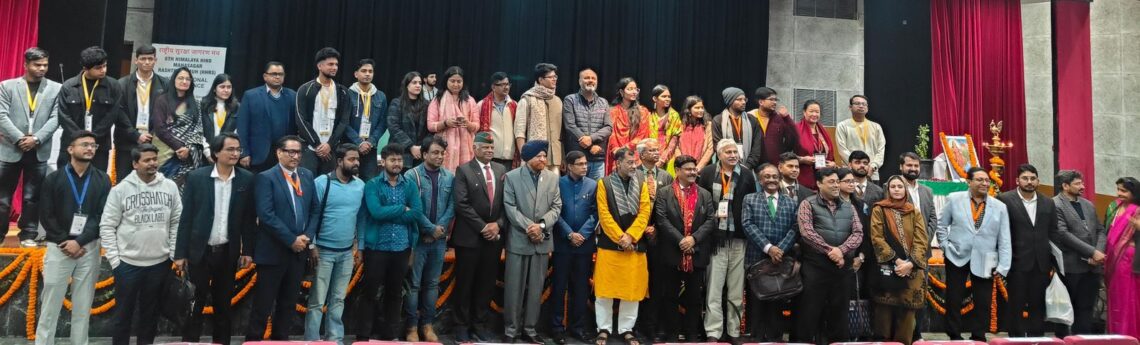
The 6th HHRS International Conference 2026 was jointly organized by the Himalaya–Indian Ocean Nations Group (HHRS) and the Rashtriya Suraksha Jagran Manch (RSJM), in collaboration with JNU, Jamia Millia Islamia, and the University of Delhi. The central theme was “India’s Geopolitical and Strategic Significance in the Indian Ocean Region.”
The conference featured multiple academic and parallel sessions with participation from over 100 scholars and researchers. Discussions focused on challenges, opportunities, and emerging trends in the Indian Ocean Region. The programme concluded with a brainstorming session on “The Way Forward,” chaired by Prof. Rizvi.
The two-day international conference emerged as a significant academic platform, reaffirming India’s cultural heritage, commitment to peace, dialogue, and constructive engagement in the Indian Ocean Region.