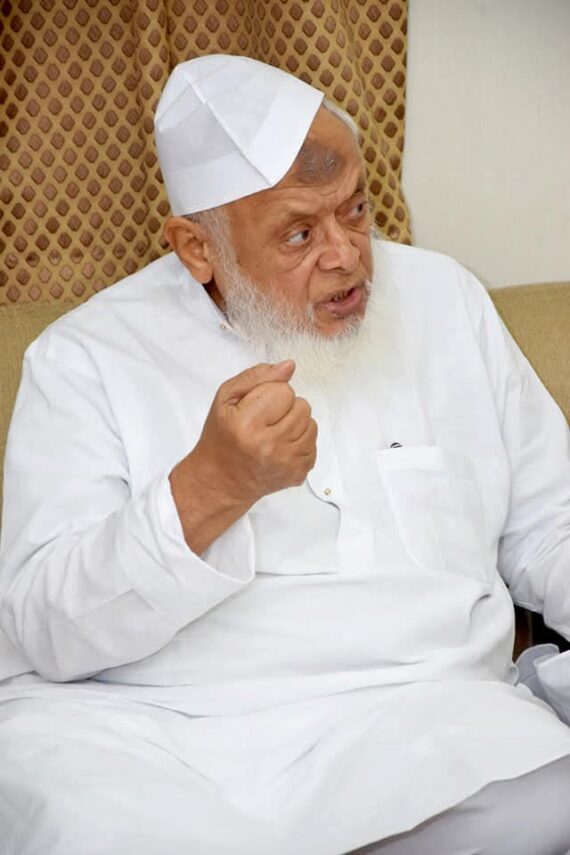
Those whose leaders sought pardon from the British are today accusing madrasas of promoting terrorism: Maulana Arshad Madani
New Delhi: President of Jamiat Ulama-i-Hind, Maulana Arshad Madani, strongly condemned the statement made by Uttar Pradesh Deputy Chief Minister Keshav Prasad Maurya, describing it as the height of communalism and prejudice. In his statement, Maurya allegedly referred to madrasas as hubs of terrorism. Maulana Madani said that such an irresponsible and provocative statement from a person holding a constitutional position is not only an insult to the dignity of that position, but also a grave affront to India’s rich scholarly and religious heritage and history. He further stated that it is equally an affront to the Constitution of India, which guarantees equal rights to all citizens, advocates equal treatment for everyone, and upholds the principle of respecting one another’s religions and traditions.
He said that only someone who is ignorant of the history of the country and its madrasas, and whose thinking is clouded by prejudice and bias, could make such a statement. Labelling the country’s millions of educational institutions, along with their millions of students, teachers, and graduates, as terrorists is highly condemnable and a deliberate attempt to undermine social harmony.
He continued his speech and said that we will tell you what the history of madrasas is. It was the scholars who graduated from these very madrasas, now being branded as hubs of terrorism, who were among the first to raise the banner of India’s freedom struggle and sacrifice their lives for the nation. They embraced the gallows with courage, endured exile, suffered long years of imprisonment, and withstood the oppression and brutality of British rule. Yet they refused to bow before the British, because the freedom of their homeland was dearer to them than their own lives.
Describing the historical role of madrasas in India, Maulana Arshad Madani said that the sacrifices made by Darul Uloom Deoband and its distinguished scholars for India’s freedom constitute a glorious chapter in the nation’s history, one that can never be forgotten.
He further said that there is also a regrettable and dark chapter in the history of the country that while Darul Uloom Deoband and its scholars and students were fighting against British colonial rule and sacrificing their precious lives for the dream of India’s freedom, certain communal and pro-British leaders of that era were submitting petitions to the British government, seeking mercy and clemency.
He clarified that these petitions for mercy and pardon submitted to the British government are part of the historical record. In those appeals, the petitioners not only sought their release but also assured the colonial authorities of their cooperation and support. In contrast, the eminent scholars of Darul Uloom Deoband, including shekhul-Hind Maulana Mahmud Hasan Deobandi, Maulana Hussain Ahmad Madani, Maulana Ubaidullah Sindhi, and their companions, chose imprisonment, exile, and every form of hardship rather than submitting to British rule. They refused to compromise on the principles of freedom and national sovereignty. For this reason, the contributions of the ulama and madrasas to India’s struggle for independence are regarded as among the brightest chapters in the nation’s history.
Maulana Madani said that it is deeply unfortunate that, for the sake of electoral and communal politics, not only Muslims but also madrasas are being continuously targeted. At times, objections are raised to their curriculum; at other times, their patriotism is questioned; and now they are being portrayed as factories of terrorism. He said that all of this reflects a political mindset aimed at promoting hatred, division, and mutual distrust within society.
Maulana Madani said that the position of the deputy Chief minister does not belong to any one political party, religion, or community; rather, it is a constitutional position that represents all the citizens of the state. He added that every public official who has taken an oath to uphold the Constitution has a fundamental responsibility to foster unity, trust, and mutual respect in society, not to make statements that hurt the sentiments of millions of citizens and undermine social harmony.
At the end he said we do not respond to hatred with hatred. However, we will continue to firmly and effectively refute every attempt to distort history, defame madrasas, and spread hatred against Muslims, because madrasas are our faith, not our worldly interest.
India’s true strength does not lie in hatred, division, or baseless allegations. Rather, it lies in its Constitution, justice, democratic values, religious freedom, brotherhood, and the glorious shared legacy of the struggle for independence. That is our national identity, and it is also the guarantee of the country’s bright future.
…
Fazlur Rhman Qasmi
Press Secretary
Jamiat Ulama-i-Hind, New Delhi
09891961134