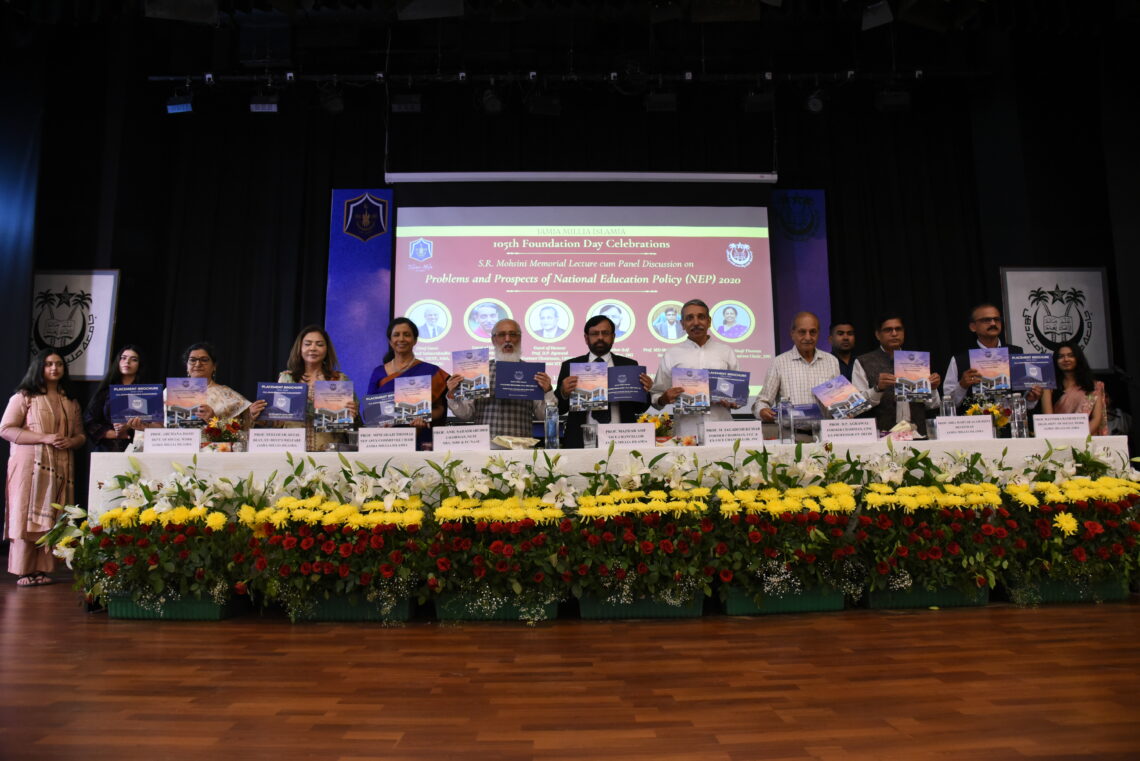
New Delhi, As part of the 105th Foundation Day celebrations of Jamia Millia Islamia (JMI), the Department of Social Work today organised a high-powered panel discussion on the topic of ‘Prospects of NEP-2020’ at the university’s Dr. M.A. Ansari Auditorium. The event was also held as part of the Department’s annual S.R. Mohsini Memorial Lecture Series. The distinguished panel comprised Prof. Anil D. Sahasrabudhe, Chairman, NETF, NBA, NIRF & EC NAAC; Prof. Mamidala Jagadesh Kumar, Former Chairman, University Grants Commission (UGC) and Former Vice-Chancellor, JNU; and Prof. D.P. Agrawal, Former Chairman, Union Public Service Commission (UPSC) in the presence of Prof. Mazhar Asif, Vice Chancellor, JMI and Prof. Md. Mahtab Alam Rizvi, Registrar, JMI.
The panellists were joined by Prof. Neelofer Afzal, Dean, Students’ Welfare; Prof. Mini Shaji Thomas, Chairperson, NEP Apex Committee, JMI; Prof. Archana Dassi, Faculty Member, Department of Social Work, who conducted the programme and Prof. R.R. Patil, Head, Department of Social Work.
The programme began with the recitation of verses from the Holy Quran, followed by a soulful rendition of the Jamia Tarana by students from Jamia School, setting a reverent tone in a packed auditorium of faculty and guests.
In his welcome address, Prof. Md. Mahtab Alam Rizvi, Registrar, JMI, acknowledged the pivotal role of the NEP drafting panel and underscored the importance of integrating Indian Knowledge Systems (IKS) in contemporary education. “Today is indeed a special day for Jamia Millia Islamia, as we have among us the stalwarts who were directly involved in the drafting and implementation of the NEP,” he said. Reflecting on the roots of political philosophy and thought, Prof. Rizvi highlighted that while the ideas of Plato, Socrates, and Aristotle have long influenced political scientists and researchers, it is equally important to study and research the great Indian knowledge traditions represented by thinkers such as Kautilya, Mahavira, and Buddha. “The National Education Policy recognises the importance of our Indian Knowledge Systems (IKS) and calls for promoting education in the mother tongue and preserving our languages and cultural heritage”. “Many nations, from China to Iraq, proudly educate their future generations in their native languages, so why shouldn’t we in India?” he asked. Prof. Rizvi observed that India’s strength lies in its diversity, stating that history shows us that, “Empires that rigidly followed a particular language or culture eventually declined. India, however, continues to flourish precisely because of its inclusiveness and diversity and its rich traditions and cultures.”
Prof. Mamidala Jagadesh Kumar, in his address on “NEP: Multiple Entry and Exit – The Spirit behind NEP 2020”, emphasized that ground-breaking research often originates from an environment that encourages imagination, critical thinking, and questioning established knowledge. For this, he said, it was important to allow curiosity among learners. This he said is reflected in the 4th year of the NEP curriculum which is dedicated to research. Giving the example of the setting up and launch of Google, Large Language Models AI, and Fibre Optic Networks, Prof. Kumar highlighted that behind several great innovations in the world of science and technology, there has been an Indian. To that extent he said that NEP focuses on, “Basic research, encouraging critical thinking among students and the development of multidisciplinary collaboration” so as to develop Indian minds, especially our large young population. He stressed the need for integrating research in undergraduate education, explaining that the youth have the greatest potential and concluded by saying, “The best time to implement the NEP is now so that we can create a sustainable, peaceful, healthy and secure future for the country.”
Prof. D.P. Agrawal, speaking on ‘Accreditation and the Role of Teachers in Driving the Implementation of NEP’, asserted that teachers are the driving force behind the success of NEP-2020. He referred to the Hon’ble Prime Minister Shri Narendra Modi’s educational vision that ‘every nation has a right to educate its people based on the ethos of its own nation’, emphasizing continuous re-skilling, technological integration, and up-skilling for all learners.
Prof. Agrawal called for the need to “learn at your own pace” which was why degrees needed to be flexible and that is the thought behind NEP which would be realised in an environment that encouraged deregulation. Distinguishing between ‘education for life and education for a skill’, Prof. Agrawal said that “NEP requires value addition of the students by the teachers and so it is the teachers who are the real driving force of NEP-2020”. He concluded by saying that our teaching-learning process has to add value for both the teachers and the students. He called for the creation of lifelong learning ecosystems and pedagogy responsive to students’ evolving needs in which teachers must be partners in the educational process, guiding ethical and socially engaged learners.
Prof. Anil D. Sahasrabudhe, congratulated JMI on its extraordinary journey spanning over a century and for having produced scores of illustrious alumni of which the nation is proud of. Delivering an enlightening talk on “Ranking: National and International Perspectives”, he remarked that while rankings keep going up and down, the research ethos and teaching-learning quality form the bedrock of academic excellence. He drew parallels between JMI’s Nai Taleem-inspired education model and NEP’s emphasis on interdisciplinarity and basic research, observing that “JMI’s multidisciplinary offerings with its 48 departments and 28 Centres of Excellence and Research is a strength and an opportunity, not a challenge.” To that extent, the university is best placed to implement NEP.
Prof. Sahasrabudhe highlighted the need for 24×7 access to research facilities, promotion of innovation and start-up ecosystems, and teacher engagement through Swayam, online and other continuous learning programmes. “Teachers must be friends, philosophers, and mentors to students,” he emphasized.
Prof. Mini Shaji Thomas, Chairperson, NEP Apex Committee, JMI, in her presentation on “Nai Taleem to NEP: A Transformational Journey from 1920–2020 and Beyond”, drew connections between Gandhian principles of craft-based education, integrated personality development, and multilingual accessibility, that were enshrined in the very foundation of JMI, noting that these ideals align closely with NEP’s core vision. She also highlighted the successful implementation of the Four-Year Undergraduate Programme (FYUP), Multiple Entry-Exit System, and Academic Bank of Credits at JMI by presenting an elaborate PPT to the audience.
Delivering the presidential address, Vice Chancellor Prof. Asif expressed gratitude to the distinguished speakers who he called his gurus and mentors for years and reaffirmed JMI’s commitment to implementing NEP-2020 diligently and fully with all its recommendations. He added, “JMI is working hard to implement the NEP and fulfil the dreams of the Honourable PM Shri Narendra Modi and the common people of India.”
Prof Asif emphasized that JMI follows the three-language formula and further in keeping with the Gandhian philosophy, his administration is making sure that every student who passes out of Jamia has one skill set that he or she has acquired. He added that JMI was proud to be student-centric and work for their welfare stating that consequent to it the university has hardly seen any cases of ragging, sexual and mental harassment.
Prof. R.R. Patil, Head, Department of Social Work, proposed the vote of thanks, acknowledging the contributions of all dignitaries, faculty members, and students.
The session concluded with the release of the Department of Social Work’s Placement Brochure.
Earlier in the day, a Book Exhibition titled “Celebrating Founders and Jamia Authors” and the release of the Bibliography of Jamia Authors Collection, organised by the Dr. Zakir Husain Library, was inaugurated as part of the Foundation Day festivities.